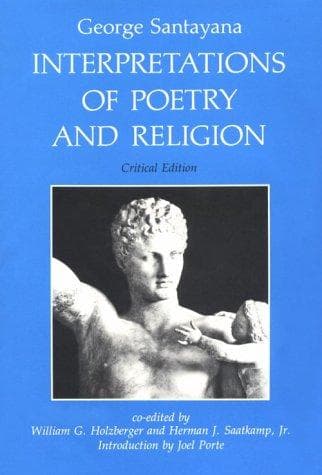
Interpretations of Poetry and ReligionSantayana, George
Religion
Interpretations of Poetry and Religion
Santayana, George
Aesthetics; Literature -- History and criticism; Poetry; Religion
And it is not found,--no, never,--in spite of what we may think when
we are first in love. Plato knew this well from his experience. He
had had successful loves, or what the world calls such, but he could
not fancy that these successes were more than provocations, more
than hints of what the true good is. To have mistaken them for real
happiness would have been to continue to dream. It would have shown
as little comprehension of the heart's experience as the idiot shows
of the experience of the senses when he is unable to put together
impressions of his eyes and hands and to say, "Here is a table; here
is a stool." It is by a parallel use of the understanding that we put
together the impressions of the heart and the imagination and are
able to say, "Here is absolute beauty: here is God." The impressions
themselves have no permanence, no intelligible essence. As Plato said,
they are never anything fixed but are always either becoming or ceasing
to be what we think them. There must be, he tells us, an eternal and
clearly definable object of which the visible appearances to us are the
manifold semblance; now by one trait now by another the phantom before
us lights up that vague and haunting idea, and makes us utter its name
with a momentary sense of certitude and attainment.
Just so the individual beauties that charm our attention and enchain
the soul have only a transitive existence; they are momentary visions,
irrecoverable moods. Their object is unstable; we never can say what
it is, it changes so quickly before our eyes. What is it that a mother
loves in her child? Perhaps the babe not yet born, or the babe that
grew long ago by her suffering and unrecognized care; perhaps the man
to be or the youth that has been. What does a man love in a woman?
The girl that is yet, perhaps, to be his, or the wife that once chose
to give him her whole existence. Where, among all these glimpses, is
the true object of love? It flies before us, it tempts us on, only
to escape and turn to mock us from a new quarter. And yet nothing
can concern us more or be more real to us than this mysterious good,
since the pursuit of it gives our lives whatever they have of true
earnestness and meaning, and the approach to it whatever they have of
joy.
Public-domain text, read in full here on John Shaqi.
Reviews
Reviews
No reviews yet
Be the first to share your thoughts on this work.
Elsewhere in the archive
Join the Discussion
Join the discussion
Sign in to leave a comment or review.
Sign InorCreate an account