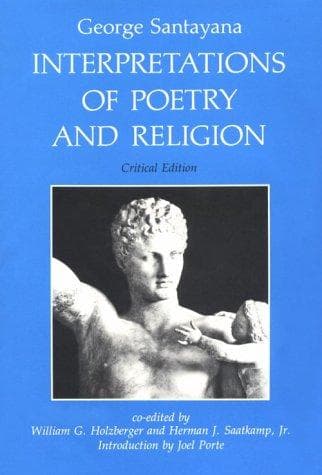
Interpretations of Poetry and ReligionSantayana, George
Religion
Interpretations of Poetry and Religion
Santayana, George
Aesthetics; Literature -- History and criticism; Poetry; Religion
So far is this ideal, Plato would say, from being an illusion, that it
is the source of the world, the power that keeps us in existence. But
for it, we should be dead. A profound indifference, an initial torpor,
would have kept us from ever opening our eyes, and we should have no
world of business or pleasure, politics or science, to think about at
all. We, and the whole universe, exist only by the passionate attempt
to return to our perfection, by the radical need of losing ourselves
again in God. That ineffable good is our natural possession; all we
honour in this life is but the partial recovery of our birthright;
every delightful thing is like a rift in the clouds through which we
catch a glimpse of our native heaven. If that heaven seems so far away
and the idea of it so dim and unreal, it is because we are so far from
perfect, so much immersed in what is alien and destructive to the soul.
Thus the history of our loves is the record of our divine
conversations, of our intercourse with heaven. It matters very
little whether this history seems to us tragic or not. In one sense,
all mortal loves are tragic because never is the creature we think
we possess the true and final object of our love; this love must
ultimately pass beyond that particular apparition, which is itself
continually passing away and shifting all its lines and colours. As
Heraclitus could never bathe twice in the same river, because its water
had flowed away, so Plato could never look twice at the same face, for
it had become another. But on the other hand the most unsuccessful
passion cannot be a vain thing. More, perhaps, than if it had found
an apparent satisfaction, it will reveal to us an object of infinite
worth, and the flight of the soul, detached by it from the illusions of
common life, will be more straight and steady toward the ultimate good.
Public-domain text, read in full here on John Shaqi.
Reviews
Reviews
No reviews yet
Be the first to share your thoughts on this work.
Elsewhere in the archive
Join the Discussion
Join the discussion
Sign in to leave a comment or review.
Sign InorCreate an account