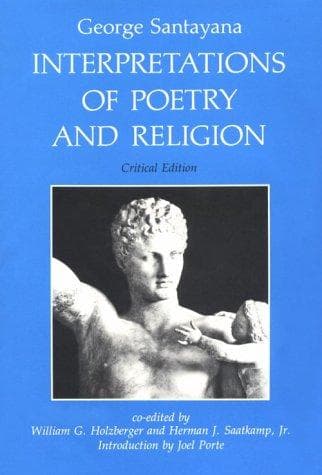
Interpretations of Poetry and ReligionSantayana, George
Religion
Interpretations of Poetry and Religion
Santayana, George
Aesthetics; Literature -- History and criticism; Poetry; Religion
Only one degree more inward than this survival of a religious
vocabulary in profane speech is the reference we often find in
Shakespeare to religious institutions and traditions. There are monks,
bishops, and cardinals; there is even mention of saints, although
none is ever presented to us in person. The clergy, if they have any
wisdom, have an earthly one. Friar Lawrence culls his herbs like a
more benevolent Medea; and Cardinal Wolsey flings away ambition with
a profoundly Pagan despair; his robe and his integrity to heaven are
cold comfort to him. Juliet goes to shrift to arrange her love affairs,
and Ophelia should go to a nunnery to forget hers. Even the chastity
of Isabella has little in it that would have been out of place in
Iphigenia. The metaphysical Hamlet himself sees a "true ghost," but so
far reverts to the positivism that underlies Shakespeare's thinking as
to speak soon after of that "undiscovered country from whose bourn no
traveller returns." There are only two or three short passages in the
plays, and one sonnet, in which true religious feeling seems to break
forth. The most beautiful of these passages is that in "Richard II,"
which commemorates the death of Mowbray, Duke of Norfolk--
"Many a time hath banished Norfolk fought
For Jesu Christ in glorious Christian field,
Streaming the ensign of the Christian cross
Against black Pagans, Turks, and Saracens;
And, toiled with works of war, retired himself
To Italy; and there, at Venice, gave
His body to that pleasant country's earth,
And his pure soul unto his captain Christ,
Under whose colours he had fought so long."
This is tender and noble, and full of an indescribable chivalry and
pathos, yet even here we find the spirit of war rather than that of
religion, and a deeper sense of Italy than of heaven. More unmixed is
the piety of Henry V after the battle of Agincourt:--
"O God, thy arm was here;
And not to us, but to thy arm alone,
Ascribe we all!--When, without stratagem,
But in plain shock and even play of battle,
Was ever known so great and little loss,
On one part and on the other?--Take it, God,
For it is none but thine....
Come, go we in procession to the village,
And be it death proclaimed through our host,
To boast of this, or take that praise from God,
Which is his only....
Do we all holy rites;
Let there be sung _Non nobis_ and _Te Deum_."
This passage is certainly a true expression of religious feeling, and
just the kind that we might expect from a dramatist. Religion appears
here as a manifestation of human nature and as an expression of human
passion. The passion, however, is not due to Shakespeare's imagination,
but is essentially historical: the poet has simply not rejected, as he
usually does, the religious element in the situation he reproduces.[1]
Public-domain text, read in full here on John Shaqi.
Reviews
Reviews
No reviews yet
Be the first to share your thoughts on this work.
Elsewhere in the archive
Join the Discussion
Join the discussion
Sign in to leave a comment or review.
Sign InorCreate an account