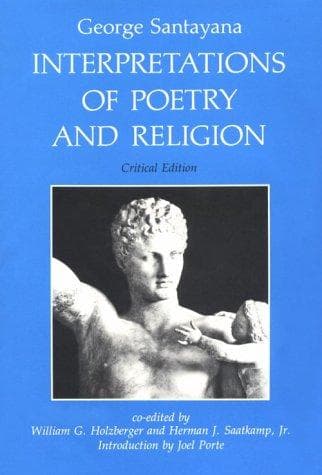
Interpretations of Poetry and ReligionSantayana, George
Religion
Interpretations of Poetry and Religion
Santayana, George
Aesthetics; Literature -- History and criticism; Poetry; Religion
With this dramatic representation of piety we may couple another, of a
more intimate kind, from the Sonnets:--
"Poor soul, the centre of my sinful earth,
Fooled by these rebel powers that thee array,
Why dost thou pine within and suffer dearth,
Painting thy outward walls so costly gay?
Why so large cost, having so short a lease,
Dost thou upon thy fading mansion spend?
Shall worms, inheritors of this excess,
Eat up thy charge? Is this thy body's end?
Then, soul, live thou upon thy servant's loss,
And let that pine to aggravate thy store;
Buy terms divine by selling hours of dross,
Within be fed, without be rich no more:
Then shalt thou feed on death, that feeds on men,
And death once dead, there's no more dying then."
This sonnet contains more than a natural religious emotion inspired by
a single event. It contains reflection, and expresses a feeling not
merely dramatically proper but rationally just. A mind that habitually
ran into such thoughts would be philosophically pious; it would be
spiritual. The Sonnets, as a whole, are spiritual; their passion is
transmuted into discipline. Their love, which, whatever its nominal
object, is hardly anything but love of beauty and youth in general,
is made to triumph over time by a metaphysical transformation of the
object into something eternal. At first this is the beauty of the race
renewing itself by generation, then it is the description of beauty in
the poet's verse, and finally it is the immortal soul enriched by the
contemplation of that beauty. This noble theme is the more impressively
rendered by being contrasted with another, with a vulgar love that by
its nature refuses to be so transformed and transmuted. "Two loves,"
cries the poet, in a line that gives us the essence of the whole, "Two
loves I have,--of comfort, and despair."
In all this depth of experience, however, there is still wanting any
religious image. The Sonnets are spiritual, but, with the doubtful
exception of the one quoted above, they are not Christian. And, of
course, a poet of Shakespeare's time could not have found any other
mould than Christianity for his religion. In our day, with our wide and
conscientious historical sympathies, it may be possible for us to find
in other rites and doctrines than those of our ancestors an expression
of some ultimate truth. But for Shakespeare, in the matter of religion,
the choice lay between Christianity and nothing. He chose nothing; he
chose to leave his heroes and himself in the presence of life and of
death with no other philosophy than that which the profane world can
suggest and understand.
Public-domain text, read in full here on John Shaqi.
Reviews
Reviews
No reviews yet
Be the first to share your thoughts on this work.
Elsewhere in the archive
Join the Discussion
Join the discussion
Sign in to leave a comment or review.
Sign InorCreate an account