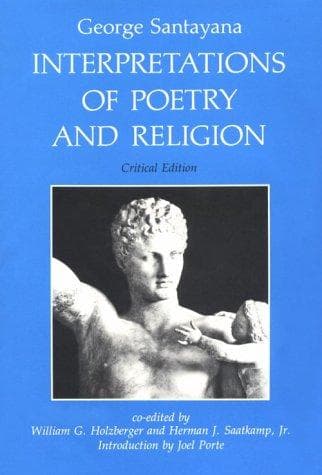
Interpretations of Poetry and ReligionSantayana, George
Religion
Interpretations of Poetry and Religion
Santayana, George
Aesthetics; Literature -- History and criticism; Poetry; Religion
Shakespeare's world, on the contrary, is only the world of human
society. The cosmos eludes him; he does not seem to feel the need
of framing that idea. He depicts human life in all its richness and
variety, but leaves that life without a setting, and consequently
without a meaning. If we asked him to tell us what is the significance
of the passion and beauty he had so vividly displayed, and what is the
outcome of it all, he could hardly answer in any other words than those
he puts into the mouth of Macbeth:--
"To-morrow, and to-morrow, and to-morrow,
Creeps in this petty pace from day to day,
To the last syllable of recorded time;
And all our yesterdays have lighted fools
The way to dusty death. Out, out, brief candle!
Life's but a walking shadow, a poor player
That struts and frets his hour upon the stage
And then is heard no more: it is a tale
Told by an idiot, full of sound and fury,
Signifying nothing."
How differently would Homer or Dante have answered that question!
Their tragedy would have been illumined by a sense of the divinity
of life and beauty, or by a sense of the sanctity of suffering and
death. Their faith had enveloped the world of experience in a world
of imagination, in which the ideals of the reason, of the fancy, and
of the heart had a natural expression. They had caught in the reality
the hint of a lovelier fable,--a fable in which that reality was
completed and idealized, and made at once vaster in its extent and more
intelligible in its principle. They had, as it were, dramatized the
universe, and endowed it with the tragic unities. In contrast with such
a luminous philosophy and so well-digested an experience, the silence
of Shakespeare and his philosophical incoherence have something in
them that is still heathen; something that makes us wonder whether the
northern mind, even in him, did not remain morose and barbarous at its
inmost core.
But before we allow ourselves such hasty and general inferences, we
may well stop to consider whether there is not some simpler answer to
our question. An epic poet, we might say, naturally deals with cosmic
themes. He needs supernatural machinery because he depicts the movement
of human affairs in their generality, as typified in the figures of
heroes whose function it is to embody or to overcome elemental forces.
Such a poet's world is fabulous, because his inspiration is impersonal.
But the dramatist renders the concrete reality of life. He has no
need of a superhuman setting for his pictures. Such a setting would
destroy the vitality of his creations. His plots should involve only
human actors and human motives: the _deus ex machina_ has always been
regarded as an inter-loper on his stage. The passions of man are his
all-sufficient material; he should weave his whole fabric out of them.
Public-domain text, read in full here on John Shaqi.
Reviews
Reviews
No reviews yet
Be the first to share your thoughts on this work.
Elsewhere in the archive
Join the Discussion
Join the discussion
Sign in to leave a comment or review.
Sign InorCreate an account