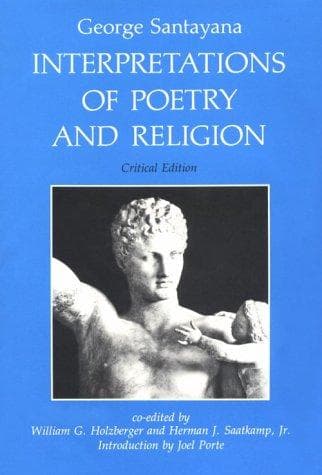
Interpretations of Poetry and ReligionSantayana, George
Religion
Interpretations of Poetry and Religion
Santayana, George
Aesthetics; Literature -- History and criticism; Poetry; Religion
To admit the truth of all this would not, however, solve our problem.
The dramatist cannot be expected to put cosmogonies on the boards.
Miracle-plays become dramatic only when they become human. But the
supernatural world, which the playwright does not bring before the
foot-lights, may exist nevertheless in the minds of his characters
and of his audience. He may refer to it, appeal to it, and imply it,
in the actions and in the sentiments he attributes to his heroes. And
if the comparison of Shakespeare with Homer or Dante on the score of
religious inspiration is invalidated by the fact that he is a dramatist
while they are epic poets, a comparison may yet be instituted between
Shakespeare and other dramatists, from which his singular insensibility
to religion will as readily appear.
Greek tragedy, as we know, is dominated by the idea of fate. Even when
the gods do not appear in person, or where the service or neglect
of them is not the moving cause of the whole play,--as it is in the
"Bacchæ" and the "Hippolytus" of Euripides,--still the deep conviction
of the limits and conditions of human happiness underlies the fable.
The will of man fulfils the decrees of Heaven. The hero manifests a
higher force than his own, both in success and in failure. The fates
guide the willing and drag the unwilling. There is no such fragmentary
view of life as we have in our romantic drama, where accidents make the
meaningless happiness or unhappiness of a supersensitive adventurer.
Life is seen whole, although in miniature. Its boundaries and its
principles are studied more than its incidents. The human, therefore,
everywhere merges with the divine. Our mortality, being sharply defined
and much insisted upon, draws the attention all the more to that
eternity of Nature and of law in which it is embosomed. Nor is the
fact of superhuman control left for our reflection to discover; it is
emphatically asserted in those oracles on which so much of the action
commonly turns.
When the Greek religion was eclipsed by the Christian, the ancient way
of conceiving the ultra-human relations of human life became obsolete.
It was no longer possible to speak with sincerity of the oracles and
gods, of Nemesis and [Greek: hubris]. Yet for a long time it was not
possible to speak in any other terms. The new ideas were without
artistic definition, and literature was paralyzed. But in the course
of ages, when the imagination had had time and opportunity to develop
a Christian art and a Christian philosophy, the dramatic poets were
ready to deal with the new themes. Only their readiness in this respect
surpassed their ability, at least their ability to please those who had
any memory of the ancient perfection of the arts.
Public-domain text, read in full here on John Shaqi.
Reviews
Reviews
No reviews yet
Be the first to share your thoughts on this work.
Elsewhere in the archive
Join the Discussion
Join the discussion
Sign in to leave a comment or review.
Sign InorCreate an account