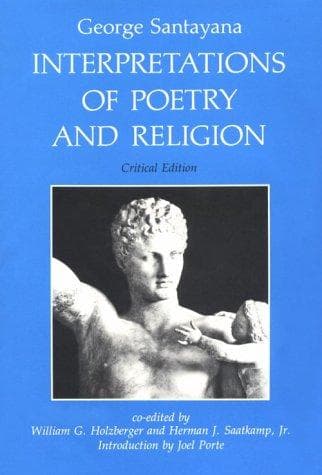
Interpretations of Poetry and ReligionSantayana, George
Religion
Interpretations of Poetry and Religion
Santayana, George
Aesthetics; Literature -- History and criticism; Poetry; Religion
When such are the usual conditions of artistic creation, we need
not wonder that Shakespeare, a poet of the Renaissance, should have
confined his representation of life to its secular aspects, and that
his readers after him should rather have marvelled at the variety of
the things of which he showed an understanding than have taken note of
the one thing he overlooked. To omit religion was after all to omit
what was not felt to be congenial to a poet's mind. The poet was to
trace for us the passionate and romantic embroideries of life; he was
to be artful and humane, and above all he was to be delightful. The
beauty and charm of things had nothing any longer to do with those
painful mysteries and contentions which made the temper of the pious
so acrid and sad. In Shakespeare's time and country, to be religious
already began to mean to be Puritanical; and in the divorce between the
fulness of life on the one hand and the depth and unity of faith on
the other, there could be no doubt to which side a man of imaginative
instincts would attach himself. A world of passion and beauty without
a meaning must seem to him more interesting and worthy than a world of
empty principle and dogma, meagre, fanatical, and false. It was beyond
the power of synthesis possessed by that age and nation to find a
principle of all passion and a religion of all life.
This power of synthesis is indeed so difficult and rare that the
attempt to gain it is sometimes condemned as too philosophical, and
as tending to embarrass the critical eye and creative imagination
with futile theories. We might say, for instance, that the absence of
religion in Shakespeare was a sign of his good sense; that a healthy
instinct kept his attention within the sublunary world; and that he
was in that respect superior to Homer and to Dante. For, while they
allowed their wisdom to clothe itself in fanciful forms, he gave us his
in its immediate truth, so that he embodied what they signified. The
supernatural machinery of their poems was, we might say, an accidental
incumbrance, a traditional means of expression, which they only half
understood, and which made their representation of life indirect and
partly unreal. Shakespeare, on the other hand, had reached his poetical
majority and independence. He rendered human experience no longer
through symbols, but by direct imaginative representation. What I have
treated as a limitation in him would, then, appear as the maturity of
his strength.
Public-domain text, read in full here on John Shaqi.
Reviews
Reviews
No reviews yet
Be the first to share your thoughts on this work.
Elsewhere in the archive
Join the Discussion
Join the discussion
Sign in to leave a comment or review.
Sign InorCreate an account