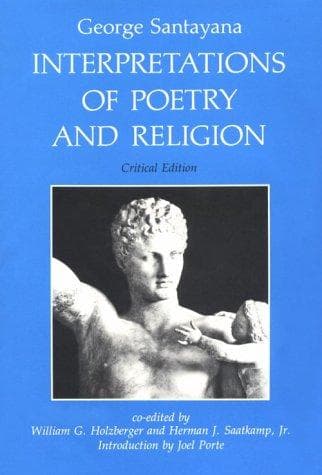
Interpretations of Poetry and ReligionSantayana, George
Religion
Interpretations of Poetry and Religion
Santayana, George
Aesthetics; Literature -- History and criticism; Poetry; Religion
There is always a class of minds in whom the spectacle of history
produces a certain apathy of reason. They flatter themselves that they
can escape defeat by not attempting the highest tasks. We need not
here stop to discuss what value as truth a philosophical synthesis may
hope to attain, nor have we to protest against the æsthetic preference
for the sketch and the episode over a reasoned and unified rendering
of life. Suffice it to say that the human race hitherto, whenever it
has reached a phase of comparatively high development and freedom,
has formed a conception of its place in Nature, no less than of the
contents of its life; and that this conception has been the occasion
of religious sentiments and practices; and further, that every art,
whether literary or plastic, has drawn its favourite themes from this
religious sphere. The poetic imagination has not commonly stopped
short of the philosophical in representing a superhuman environment of
man.
Shakespeare, however, is remarkable among the greater poets for being
without a philosophy and without a religion. In his drama there is
no fixed conception of any forces, natural or moral, dominating and
transcending our mortal energies. Whether this characteristic be
regarded as a merit or as a defect, its presence cannot be denied.
Those who think it wise or possible to refrain from searching for
general principles, and are satisfied with the successive empirical
appearance of things, without any faith in their rational continuity or
completeness, may well see in Shakespeare their natural prophet. For
he, too, has been satisfied with the successive description of various
passions and events. His world, like the earth before Columbus, extends
in an indefinite plane which he is not tempted to explore.
Those of us, however, who believe in circumnavigation, and who think
that both human reason and human imagination require a certain totality
in our views, and who feel that the most important thing in life is the
lesson of it, and its relation to its own ideal,--we can hardly find
in Shakespeare all that the highest poet could give. Fulness is not
necessarily wholeness, and the most profuse wealth of characterization
seems still inadequate as a picture of experience, if this picture is
not somehow seen from above and reduced to a dramatic unity,--to that
unity of meaning that can suffuse its endless details with something of
dignity, simplicity, and peace. This is the imaginative power found in
several poets we have mentioned,--the power that gives certain passages
in Lucretius also their sublimity, as it gives sublimity to many
passages in the Bible.
Public-domain text, read in full here on John Shaqi.
Reviews
Reviews
No reviews yet
Be the first to share your thoughts on this work.
Elsewhere in the archive
Join the Discussion
Join the discussion
Sign in to leave a comment or review.
Sign InorCreate an account