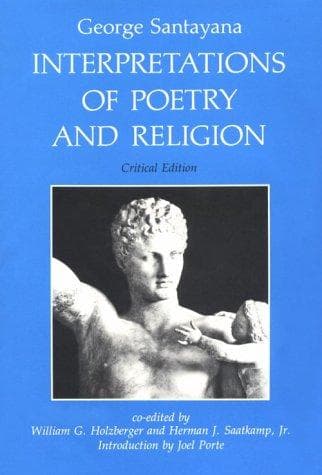
Interpretations of Poetry and ReligionSantayana, George
Religion
Interpretations of Poetry and Religion
Santayana, George
Aesthetics; Literature -- History and criticism; Poetry; Religion
It is an observation at first sight melancholy but in the end, perhaps,
enlightening, that the earliest poets are the most ideal, and that
primitive ages furnish the most heroic characters and have the clearest
vision of a perfect life. The Homeric times must have been full of
ignorance and suffering. In those little barbaric towns, in those camps
and farms, in those shipyards, there must have been much insecurity
and superstition. That age was singularly poor in all that concerns
the convenience of life and the entertainment of the mind with arts
and sciences. Yet it had a sense for civilization. That machinery of
life which men were beginning to devise appealed to them as poetical;
they knew its ultimate justification and studied its incipient
processes with delight. The poetry of that simple and ignorant age was,
accordingly, the sweetest and sanest that the world has known; the
most faultless in taste, and the most even and lofty in inspiration.
Without lacking variety and homeliness, it bathed all things human in
the golden light of morning; it clothed sorrow in a kind of majesty,
instinct with both self-control and heroic frankness. Nowhere else can
we find so noble a rendering of human nature, so spontaneous a delight
in life, so uncompromising a dedication to beauty, and such a gift of
seeing beauty in everything. Homer, the first of poets, was also the
best and the most poetical.
From this beginning, if we look down the history of Occidental
literature, we see the power of idealization steadily decline. For
while it finds here and there, as in Dante, a more spiritual theme
and a subtler and riper intellect, it pays for that advantage by a
more than equivalent loss in breadth, sanity, and happy vigour. And if
ever imagination bursts out with a greater potency, as in Shakespeare
(who excels the patriarch of poetry in depth of passion and vividness
of characterization, and in those exquisite bubblings of poetry and
humour in which English genius is at its best), yet Shakespeare also
pays the price by a notable loss in taste, in sustained inspiration,
in consecration, and in rationality. There is more or less rubbish in
his greatest works. When we come down to our own day _we_ find poets of
hardly less natural endowment (for in endowment all ages are perhaps
alike) and with vastly richer sources of inspiration; for they have
many arts and literatures behind them, with the spectacle of a varied
and agitated society, a world which is the living microcosm of its own
history and presents in one picture many races, arts, and religions.
Our poets have more wonderful tragedies of the imagination to depict
than had Homer, whose world was innocent of any essential defeat,
or Dante, who believed in the world's definitive redemption. Or, if
perhaps their inspiration is comic, they have the pageant of mediæval
manners, with its picturesque artifices and passionate fancies, and the
Public-domain text, read in full here on John Shaqi.
Reviews
Reviews
No reviews yet
Be the first to share your thoughts on this work.
Elsewhere in the archive
Join the Discussion
Join the discussion
Sign in to leave a comment or review.
Sign InorCreate an account