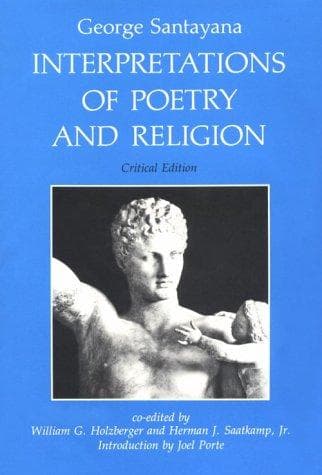
Interpretations of Poetry and ReligionSantayana, George
Religion
Interpretations of Poetry and Religion
Santayana, George
Aesthetics; Literature -- History and criticism; Poetry; Religion
long comedy of modern social revolutions, so illusory in their aims and
so productive in their aimlessness. They have, moreover, the new and
marvellous conception which natural science has given us of the world
and of the conditions of human progress.
With all these lessons of experience behind them, however, we find
our contemporary poets incapable of any high wisdom, incapable of any
imaginative rendering of human life and its meaning. Our poets are
things of shreds and patches; they give us episodes and studies, a
sketch of this curiosity, a glimpse of that romance; they have no total
vision, no grasp of the whole reality, and consequently no capacity for
a sane and steady idealization. The comparatively barbarous ages had a
poetry of the ideal; they had visions of beauty, order, and perfection.
This age of material elaboration has no sense for those things. Its
fancy is retrospective, whimsical, and flickering; its ideals, when
it has any, are negative and partial; its moral strength is a blind
and miscellaneous vehemence. Its poetry, in a word, is the poetry of
barbarism.
This poetry should be viewed in relation to the general moral crisis
and imaginative disintegration of which it gives a verbal echo; then
we shall avoid the injustice of passing it over as insignificant, no
less than the imbecility of hailing it as essentially glorious and
successful. We must remember that the imagination of our race has been
subject to a double discipline. It has been formed partly in the school
of classic literature and polity, and partly in the school of Christian
piety. This duality of inspiration, this contradiction between the two
accepted methods of rationalizing the world, has been a chief source
of that incoherence, that romantic indistinctness and imperfection,
which largely characterize the products of the modern arts. A main
cannot serve two masters; yet the conditions have not been such as to
allow him wholly to despise the one or wholly to obey the other. To be
wholly Pagan is impossible after the dissolution of that civilization
which had seemed universal, and that empire which had believed itself
eternal. To be wholly Christian is impossible for a similar reason, now
that the illusion and cohesion of Christian ages is lost, and for the
further reason that Christianity was itself fundamentally eclectic.
Before it could succeed and dominate men even for a time, it was
obliged to adjust itself to reality, to incorporate many elements of
Pagan wisdom, and to accommodate itself to many habits and passions at
variance with its own ideal.
Public-domain text, read in full here on John Shaqi.
Reviews
Reviews
No reviews yet
Be the first to share your thoughts on this work.
Elsewhere in the archive
Join the Discussion
Join the discussion
Sign in to leave a comment or review.
Sign InorCreate an account