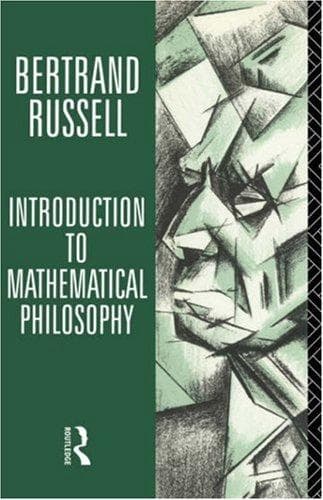
Introduction to Mathematical PhilosophyRussell, Bertrand
Philosophy
Introduction to Mathematical Philosophy
Russell, Bertrand
Mathematics -- Philosophy
When descriptions occur in propositions, it is necessary to
distinguish what may be called "primary" and "secondary"
occurrences. The abstract distinction is as follows. A description
has a "primary" occurrence when the proposition in
which it occurs results from substituting the description for ""
in some propositional function ; a description has a
"secondary" occurrence when the result of substituting the
description for in gives only part of the proposition concerned.
An instance will make this clearer. Consider "the
present King of France is bald." Here "the present King of
France" has a primary occurrence, and the proposition is false.
Every proposition in which a description which describes nothing
has a primary occurrence is false. But now consider "the
present King of France is not bald." This is ambiguous. If
we are first to take " is bald," then substitute "the present
King of France" for "" and then deny the result, the occurrence
of "the present King of France" is secondary and our proposition
is true; but if we are to take " is not bald" and substitute
"the present King of France" for "" then "the present
King of France" has a primary occurrence and the proposition
is false. Confusion of primary and secondary occurrences is a
ready source of fallacies where descriptions are concerned.
[Pg 179]
Descriptions occur in mathematics chiefly in the form of
descriptive functions, i.e. "the term having the
relation to ,"
or "the of " as we may say, on the analogy of "the
father of " and similar phrases. To say "the father of is
rich," for example, is to say that the following propositional
function of : " is rich, and ' begat ' is always equivalent
to 'is ,'" is "sometimes true," i.e. is true for at least one
value of . It obviously cannot be true for more than one
value.
The theory of descriptions, briefly outlined in the present
chapter, is of the utmost importance both in logic and in theory
of knowledge. But for purposes of mathematics, the more
philosophical parts of the theory are not essential, and have
therefore been omitted in the above account, which has confined
itself to the barest mathematical requisites.
[Pg 180]
CHAPTER XVII
CLASSES
Public-domain text, read in full here on John Shaqi.
Reviews
Reviews
No reviews yet
Be the first to share your thoughts on this work.
Elsewhere in the archive
Join the Discussion
Join the discussion
Sign in to leave a comment or review.
Sign InorCreate an account