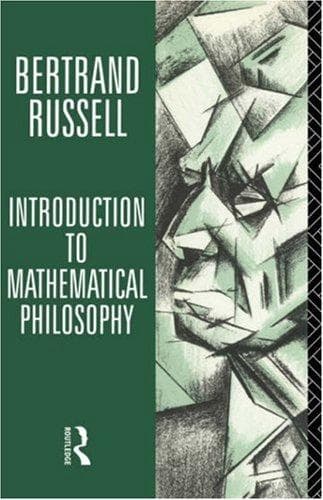
Introduction to Mathematical PhilosophyRussell, Bertrand
Philosophy
Introduction to Mathematical Philosophy
Russell, Bertrand
Mathematics -- Philosophy
IN the present chapter we shall be concerned with the in the
plural: the inhabitants of London, the sons of rich men, and
so on. In other words, we shall be concerned with classes. We
saw in Chapter II. that a cardinal number is to be defined as a
class of classes, and in Chapter III. that the number 1 is to be
defined as the class of all unit classes, i.e. of all that have just
one member, as we should say but for the vicious circle. Of
course, when the number 1 is defined as the class of all unit
classes, "unit classes" must be defined so as not to assume
that we know what is meant by "one"; in fact, they are defined
in a way closely analogous to that used for descriptions, namely:
A class is said to be a "unit" class if the propositional function
"' is an ' is always equivalent to ' is '" (regarded as a
function of ) is not always false, i.e., in more ordinary language,
if there is a term such that will be a member of
when is
but not otherwise. This gives us a definition of a unit class if we
already know what a class is in general. Hitherto we have, in
dealing with arithmetic, treated "class" as a primitive idea.
But, for the reasons set forth in Chapter XIII., if for no others,
we cannot accept "class" as a primitive idea. We must seek a
definition on the same lines as the definition of descriptions,
i.e. a definition which will assign a meaning to propositions in
whose verbal or symbolic expression words or symbols apparently
representing classes occur, but which will assign a meaning that
altogether eliminates all mention of classes from a right analysis
[Pg 181]
of such propositions. We shall then be able to say that the
symbols for classes are mere conveniences, not representing
objects called "classes," and that classes are in fact, like descriptions,
logical fictions, or (as we say) "incomplete symbols."
The theory of classes is less complete than the theory of descriptions,
and there are reasons (which we shall give in outline)
for regarding the definition of classes that will be suggested as
not finally satisfactory. Some further subtlety appears to be
required; but the reasons for regarding the definition which
will be offered as being approximately correct and on the right
lines are overwhelming.
Public-domain text, read in full here on John Shaqi.
Reviews
Reviews
No reviews yet
Be the first to share your thoughts on this work.
Elsewhere in the archive
Join the Discussion
Join the discussion
Sign in to leave a comment or review.
Sign InorCreate an account