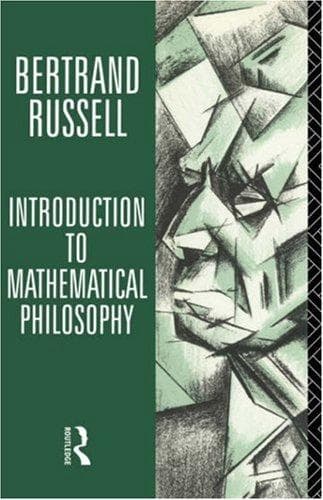
Introduction to Mathematical PhilosophyRussell, Bertrand
Philosophy
Introduction to Mathematical Philosophy
Russell, Bertrand
Mathematics -- Philosophy
We shall come much nearer to a satisfactory theory if we
try to identify classes with propositional functions. Every
class, as we explained in Chapter II., is defined by some propositional
function which is true of the members of the class
and false of other things. But if a class can be defined by one
propositional function, it can equally well be defined by any
other which is true whenever the first is true and false whenever
the first is false. For this reason the class cannot be identified
with any one such propositional function rather than with
any other—and given a propositional function, there are always
many others which are true when it is true and false when it is
false. We say that two propositional functions are "formally
equivalent" when this happens. Two propositions are "equivalent"
[Pg 183]
when both are true or both false; two propositional
functions , are "formally equivalent" when is always
equivalent to . It is the fact that there are other functions
formally equivalent to a given function that makes it impossible
to identify a class with a function; for we wish classes to be such
that no two distinct classes have exactly the same members,
and therefore two formally equivalent functions will have to
determine the same class.
When we have decided that classes cannot be things of the
same sort as their members, that they cannot be just heaps or
aggregates, and also that they cannot be identified with propositional
functions, it becomes very difficult to see what they
can be, if they are to be more than symbolic fictions. And if
we can find any way of dealing with them as symbolic fictions,
we increase the logical security of our position, since we avoid
the need of assuming that there are classes without being compelled
to make the opposite assumption that there are no classes.
We merely abstain from both assumptions. This is an example
of Occam's razor, namely, "entities are not to be multiplied
without necessity." But when we refuse to assert that there
are classes, we must not be supposed to be asserting dogmatically
that there are none. We are merely agnostic as regards them:
like Laplace, we can say, "je n'ai pas besoin de cette hypothèse."
Let us set forth the conditions that a symbol must fulfil if
it is to serve as a class. I think the following conditions will
be found necessary and sufficient:—
Public-domain text, read in full here on John Shaqi.
Reviews
Reviews
No reviews yet
Be the first to share your thoughts on this work.
Elsewhere in the archive
Join the Discussion
Join the discussion
Sign in to leave a comment or review.
Sign InorCreate an account