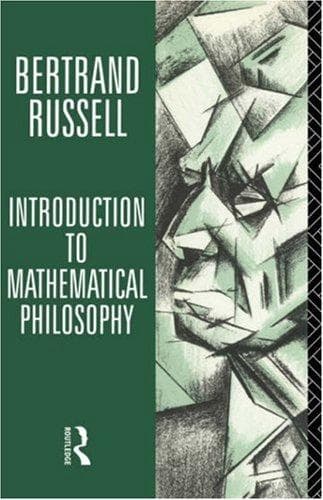
Introduction to Mathematical PhilosophyRussell, Bertrand
Philosophy
Introduction to Mathematical Philosophy
Russell, Bertrand
Mathematics -- Philosophy
MATHEMATICS and logic, historically speaking, have been entirely
distinct studies. Mathematics has been connected with science,
logic with Greek. But both have developed in modern times:
logic has become more mathematical and mathematics has
become more logical. The consequence is that it has now become
wholly impossible to draw a line between the two; in fact, the
two are one. They differ as boy and man: logic is the youth
of mathematics and mathematics is the manhood of logic. This
view is resented by logicians who, having spent their time in
the study of classical texts, are incapable of following a piece
of symbolic reasoning, and by mathematicians who have learnt
a technique without troubling to inquire into its meaning or
justification. Both types are now fortunately growing rarer.
So much of modern mathematical work is obviously on the
border-line of logic, so much of modern logic is symbolic and
formal, that the very close relationship of logic and mathematics
has become obvious to every instructed student. The proof
of their identity is, of course, a matter of detail: starting with
premisses which would be universally admitted to belong to
logic, and arriving by deduction at results which as obviously
belong to mathematics, we find that there is no point at which
a sharp line can be drawn, with logic to the left and mathematics
to the right. If there are still those who do not admit
the identity of logic and mathematics, we may challenge them
to indicate at what point, in the successive definitions and
[Pg 194]
deductions of Principia Mathematica, they consider that logic
ends and mathematics begins. It will then be obvious that any
answer must be quite arbitrary.
In the earlier chapters of this book, starting from the natural
numbers, we have first defined "cardinal number" and shown
how to generalise the conception of number, and have then
analysed the conceptions involved in the definition, until we found
ourselves dealing with the fundamentals of logic. In a synthetic,
deductive treatment these fundamentals come first, and the
natural numbers are only reached after a long journey. Such
treatment, though formally more correct than that which we
have adopted, is more difficult for the reader, because the ultimate
logical concepts and propositions with which it starts are remote
and unfamiliar as compared with the natural numbers. Also
they represent the present frontier of knowledge, beyond which
is the still unknown; and the dominion of knowledge over them
is not as yet very secure.
Public-domain text, read in full here on John Shaqi.
Reviews
Reviews
No reviews yet
Be the first to share your thoughts on this work.
Elsewhere in the archive
Join the Discussion
Join the discussion
Sign in to leave a comment or review.
Sign InorCreate an account