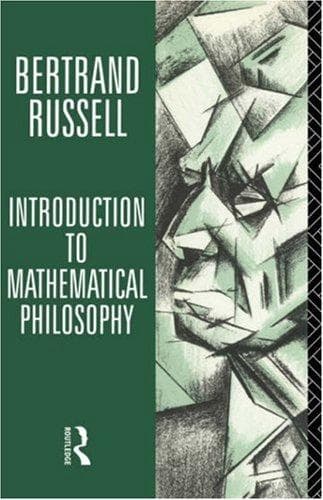
Introduction to Mathematical PhilosophyRussell, Bertrand
Philosophy
Introduction to Mathematical Philosophy
Russell, Bertrand
Mathematics -- Philosophy
It used to be said that mathematics is the science of "quantity."
"Quantity" is a vague word, but for the sake of argument
we may replace it by the word "number." The statement
that mathematics is the science of number would be untrue
in two different ways. On the one hand, there are recognised
branches of mathematics which have nothing to do with number—all
geometry that does not use co-ordinates or measurement,
for example: projective and descriptive geometry, down to
the point at which co-ordinates are introduced, does not have
to do with number, or even with quantity in the sense of greater
and less. On the other hand, through the definition of cardinals,
through the theory of induction and ancestral relations, through
the general theory of series, and through the definitions of the
arithmetical operations, it has become possible to generalise much
that used to be proved only in connection with numbers. The
result is that what was formerly the single study of Arithmetic
has now become divided into numbers of separate studies, no
one of which is specially concerned with numbers. The most
[Pg 195]
elementary properties of numbers are concerned with one-one
relations, and similarity between classes. Addition is concerned
with the construction of mutually exclusive classes respectively
similar to a set of classes which are not known to be mutually
exclusive. Multiplication is merged in the theory of "selections,"
i.e. of a certain kind of one-many relations. Finitude
is merged in the general study of ancestral relations, which yields
the whole theory of mathematical induction. The ordinal
properties of the various kinds of number-series, and the elements
of the theory of continuity of functions and the limits of functions,
can be generalised so as no longer to involve any essential reference
to numbers. It is a principle, in all formal reasoning, to generalise
to the utmost, since we thereby secure that a given process of
deduction shall have more widely applicable results; we are,
therefore, in thus generalising the reasoning of arithmetic,
merely following a precept which is universally admitted in
mathematics. And in thus generalising we have, in effect,
created a set of new deductive systems, in which traditional
arithmetic is at once dissolved and enlarged; but whether any
one of these new deductive systems—for example, the theory of
selections—is to be said to belong to logic or to arithmetic is
entirely arbitrary, and incapable of being decided rationally.
We are thus brought face to face with the question: What
is this subject, which may be called indifferently either mathematics
or logic? Is there any way in which we can define it?
Public-domain text, read in full here on John Shaqi.
Reviews
Reviews
No reviews yet
Be the first to share your thoughts on this work.
Elsewhere in the archive
Join the Discussion
Join the discussion
Sign in to leave a comment or review.
Sign InorCreate an account