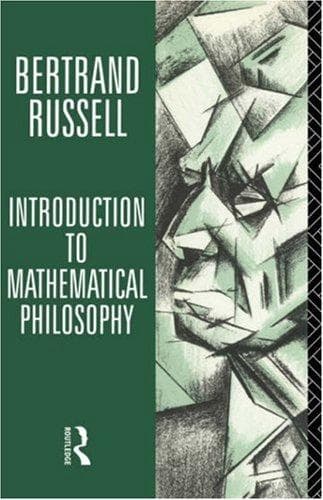
Introduction to Mathematical Philosophy — John Shaqi
Introduction to Mathematical PhilosophyRussell, Bertrand
Philosophy
Introduction to Mathematical Philosophy
Russell, Bertrand
Mathematics -- Philosophy
Having reduced all traditional pure mathematics to the
theory of the natural numbers, the next step in logical analysis
was to reduce this theory itself to the smallest set of premisses
and undefined terms from which it could be derived. This work
was accomplished by Peano. He showed that the entire theory
of the natural numbers could be derived from three primitive
ideas and five primitive propositions in addition to those of
pure logic. These three ideas and five propositions thus became,
as it were, hostages for the whole of traditional pure mathematics.
If they could be defined and proved in terms of others,
so could all pure mathematics. Their logical "weight," if one
may use such an expression, is equal to that of the whole series
of sciences that have been deduced from the theory of the natural
numbers; the truth of this whole series is assured if the truth
of the five primitive propositions is guaranteed, provided, of
course, that there is nothing erroneous in the purely logical
apparatus which is also involved. The work of analysing mathematics
is extraordinarily facilitated by this work of Peano's.
The three primitive ideas in Peano's arithmetic are:
By "successor" he means the next number in the natural
order. That is to say, the successor of 0 is 1, the successor of
1 is 2, and so on. By "number" he means, in this connection,
the class of the natural numbers.[2]
He is not assuming that
we know all the members of this class, but only that we know
what we mean when we say that this or that is a number, just
as we know what we mean when we say "Jones is a man,"
though we do not know all men individually.
[2]We shall use "number" in this sense in the present chapter. Afterwards
the word will be used in a more general sense.
The five primitive propositions which Peano assumes are:
(1) 0 is a number.
(2) The successor of any number is a number.
(3) No two numbers have the same successor.
[Pg 5]
(4) 0 is not the successor of any number.
(5) Any property which belongs to 0, and also to the successor
of every number which has the property, belongs to all
numbers.
The last of these is the principle of mathematical induction.
We shall have much to say concerning mathematical induction
in the sequel; for the present, we are concerned with it only
as it occurs in Peano's analysis of arithmetic.
Public-domain text, read in full here on John Shaqi.
Reviews
Reviews
No reviews yet
Be the first to share your thoughts on this work.
Join the Discussion
Join the discussion
Sign in to leave a comment or review.
Sign InorCreate an account