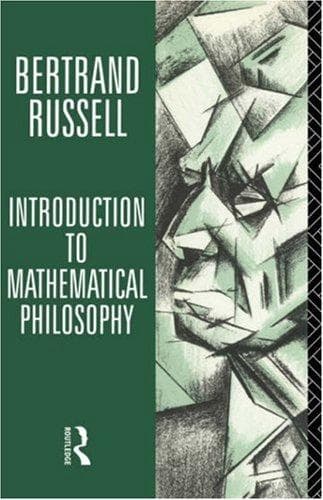
Introduction to Mathematical PhilosophyRussell, Bertrand
Philosophy
Introduction to Mathematical Philosophy
Russell, Bertrand
Mathematics -- Philosophy
The characteristic by which we defined finitude was mathematical
induction, i.e. we defined a number as finite when it
obeys mathematical induction starting from 0, and a class as
finite when its number is finite. This definition yields the sort
of result that a definition ought to yield, namely, that the finite
[Pg 87]
numbers are those that occur in the ordinary number-series
0, 1, 2, 3, ... But in the present chapter, the infinite numbers
we have discussed have not merely been non-inductive:
they have also been reflexive. Cantor used reflexiveness as the
definition of the infinite, and believes that it is equivalent to
non-inductiveness; that is to say, he believes that every class
and every cardinal is either inductive or reflexive. This may be
true, and may very possibly be capable of proof; but the proofs
hitherto offered by Cantor and others (including the present
author in former days) are fallacious, for reasons which will be
explained when we come to consider the "multiplicative axiom."
At present, it is not known whether there are classes and cardinals
which are neither reflexive nor inductive. If were such a
cardinal, we should not have , but would not be one
of the "natural numbers," and would be lacking in some of the
inductive properties. All known infinite classes and cardinals
are reflexive; but for the present it is well to preserve an open
mind as to whether there are instances, hitherto unknown, of
classes and cardinals which are neither reflexive nor inductive.
Meanwhile, we adopt the following definitions:—
A finite class or cardinal is one which is inductive.
An infinite class or cardinal is one which is not inductive.
All reflexive classes and cardinals are infinite; but it is not known
at present whether all infinite classes and cardinals are reflexive.
We shall return to this subject in Chapter XII.
[Pg 88]
CHAPTER IX
INFINITE SERIES AND ORDINALS
AN "infinite series" may be defined as a series of which the field
is an infinite class. We have already had occasion to consider
one kind of infinite series, namely, progressions. In this chapter
we shall consider the subject more generally.
The most noteworthy characteristic of an infinite series is
that its serial number can be altered by merely re-arranging
its terms. In this respect there is a certain oppositeness between
cardinal and serial numbers. It is possible to keep the cardinal
number of a reflexive class unchanged in spite of adding terms
to it; on the other hand, it is possible to change the serial
number of a series without adding or taking away any terms,
by mere re-arrangement. At the same time, in the case of any
infinite series it is also possible, as with cardinals, to add terms
without altering the serial number: everything depends upon
the way in which they are added.
Public-domain text, read in full here on John Shaqi.
Reviews
Reviews
No reviews yet
Be the first to share your thoughts on this work.
Elsewhere in the archive
Join the Discussion
Join the discussion
Sign in to leave a comment or review.
Sign InorCreate an account