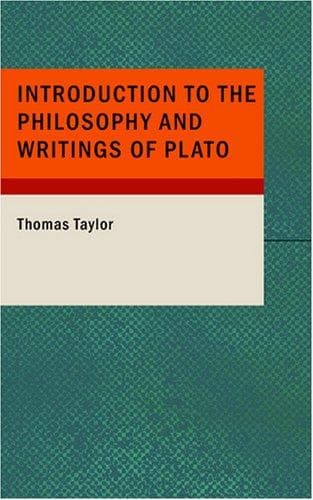
Introduction to the Philosophy and Writings of PlatoTaylor, Thomas
Philosophy
Introduction to the Philosophy and Writings of Plato
Taylor, Thomas
Philosophy; Plato
After this general view of the dialogues of Plato, let us in the next
place consider their preambles, the digressions with which they abound,
and the character of the style in which they are written. With respect to
the first of these, the preambles, however superfluous they may at first
sight appear, they will be found on a closer inspection necessary to the
design of the dialogues which they accompany. Thus the prefatory part of
the Timaeus unfolds, in images agreeably to the Pythagoric custom, the
theory of the world; and the first part of the Parmenides, or the
discussion of ideas, is in fact merely a preamble to the second part,
or the speculation of the one; to which however it is essentially
preparatory. Hence, as Plutarch says, when he speaks of Plato's dialogue
on the Atlantic island: These preambles are superb gates and magnificent
courts with which he purposely embellishes his great edifices, that
nothing may be wanting to their beauty, and that all may be equally
splendid. He acts, as Dacier well observes, like a great prince, who,
when he builds a sumptuous palace, adorns (in the language of Pindar) the
vestibule with golden pillars. For it is fit that what is first seen
should be splendid and magnificent, and should as it were perspicuously
announce all that grandeur which afterwards presents itself to the view.
With respect to the frequent digressions in his dialogues, these also,
when accurately examined, will be found to be no less subservient to the
leading design of the dialogues in which they are introduced; at the same
time that they afford a pleasing relaxation to the mind from the labor of
severe investigation. Hence Plato, by the most happy and enchanting art,
contrives to lead the reader to the temple of Truth through the delightful
groves and valleys of the Graces. In short, this circuitous course, when
attentively considered, will be found to be the shortest road by which he
could conduct the reader to the desired end: for in accomplishing this it
is necessary to regard not that road, which is most straight in the
nature of things, or abstractedly considered, but that which is most
direct in the progressions of human understanding.
Public-domain text, read in full here on John Shaqi.
Reviews
Reviews
No reviews yet
Be the first to share your thoughts on this work.
Elsewhere in the archive
Join the Discussion
Join the discussion
Sign in to leave a comment or review.
Sign InorCreate an account