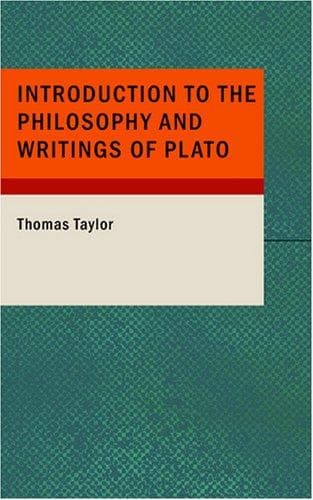
Introduction to the Philosophy and Writings of PlatoTaylor, Thomas
Philosophy
Introduction to the Philosophy and Writings of Plato
Taylor, Thomas
Philosophy; Plato
With respect to the style of Plato, though it forms in reality the
most inconsiderable part of the merit of his writings, style in all
philosophical works being the last thing that should be attended to, yet
even in this Plato may contend for the palm of excellence with the most
renowned masters of diction. Hence we find that his style was the
admiration of the finest writers of antiquity. According to Ammianus,
Jupiter himself would not speak otherwise, if he were to converse in the
Attic tongue. Aristotle considered his style as a medium between poetry
and prose. Cicero no less praises him for the excellence of his diction
than the profundity of his conceptions; and Longinus calls him with
respect to his language, the rival of Homer. Hence he is considered by
this prince of critics, as deriving into himself abundant streams from
the Homeric fountain, and is compared by him, in his rivalship of Homer,
to a new antagonist who enters the lists against one that is already the
object of universal admiration.
Notwithstanding this praise, however, Plato has been accused, as Longinus
informs us, of being frequently hurried away as by a certain Bacchic fury
of words to immoderate and unpleasant metaphors, and an allegoric
magnificence of diction. Longinus excuses this by saying that whatever
naturally excels in magnitude possesses very little of purity. For that,
says he, which is in every respect accurate is in danger of littleness.
He adds, "and may not this also be necessary, that those of an abject and
moderate genius, because they never encounter danger, nor aspire after
the summit of excellence, are for the most part without error and remain
in security; but that great things become insecure through their magnitude?"
Indeed it appears to me, that whenever this exuberance, this Bacchic
fury, occurs in the diction of Plato, it is owing to the magnitude of the
inspiring influence of deity with which he is then replete. For that he
sometimes wrote from divine inspiration is evident from his own confession
in the Phaedrus, a great part of which is not so much like an orderly
discourse as a dithyrambic poem. Such a style therefore, as it is the
progeny of divine mania, which, as Plato justly observes, is better than
all human prudence, spontaneously adapts itself to its producing cause,
imitates a supernatural power as far as this can be effected by words,
and thus necessarily becomes magnificent, vehement, and exuberant; for
such are the characteristics of its source. All judges of composition
however, both ancient and modern, are agreed that his style is in general
graceful and pure; and that it is sublime without being impetuous and
rapid. It is indeed no less harmonious than elevated, no less accurate[27]
than magnificent. It combines the force of the greatest orators with the
graces of the first of poets; and in short; is a river to which those
justly celebrated lines of Denham may be most pertinently applied:
Public-domain text, read in full here on John Shaqi.
Reviews
Reviews
No reviews yet
Be the first to share your thoughts on this work.
Elsewhere in the archive
Join the Discussion
Join the discussion
Sign in to leave a comment or review.
Sign InorCreate an account