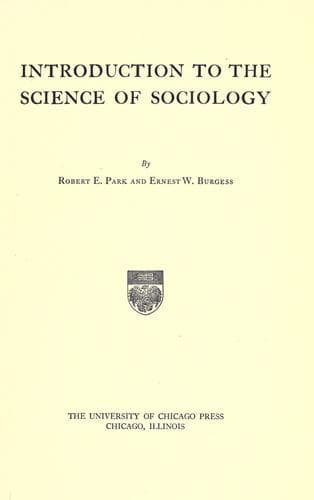
Introduction to the Science of SociologyPark, Robert Ezra
General
Introduction to the Science of Sociology
Park, Robert Ezra
Sociology
Human beings as we find them are artificial products; and for better or
for worse they must always be such. Nature has made us: social action
and our own efforts must continually remake us. Any attempt to reject
art for "nature" can only result in an artificial naturalness which is
far less genuine and less pleasing than the natural work of art.
Further, as self-consciousness varies, the amount or degree of this
remaking activity will vary. Among the extremely few respects in which
human history shows unquestionable growth we must include the degree and
range of self-consciousness. The gradual development of psychology as a
science and the persistent advance of the subjective or introspective
element in literature and in all fine art are tokens of this change. And
as a further indication and result, the art of human reshaping has taken
definite character, has left its incidental beginnings far behind, has
become an institution, a group of institutions.
Wherever a language exists, as a magazine of established meanings, there
will be found a repertoire of epithets of praise and blame, at once
results and implements of this social process. The simple existence of
such a vocabulary acts as a persistent force; but the effect of current
ideals is redoubled when a coherent agency, such as public religion,
assumes protection of the most searching social maxims and lends to them
the weight of all time, all space, all wonder, and all fear. For many
centuries religion held within itself the ripening self-knowledge and
self-discipline of the human mind. Now, beside this original agency we
have its offshoots, politics, education, legislation, the penal art. And
the philosophical sciences, including psychology and ethics, are the
especial servants of these arts.
As to structure, human nature is undoubtedly the most plastic part of
the living world, the most adaptable, the most educable. Of all animals,
it is man in whom heredity counts for least, and conscious building
forces for most. Consider that his infancy is longest, his instincts
least fixed, his brain most unfinished at birth, his powers of
habit-making and habit-changing most marked, his susceptibility to
social impressions keenest; and it becomes clear that in every way
nature, as a prescriptive power, has provided in him for her own
displacement. His major instincts and passions first appear on the
scene, not as controlling forces, but as elements of _play_, in a
prolonged life of play. Other creatures nature could largely finish: the
human creature must finish himself.
Public-domain text, read in full here on John Shaqi.
Reviews
Reviews
No reviews yet
Be the first to share your thoughts on this work.
Elsewhere in the archive
Join the Discussion
Join the discussion
Sign in to leave a comment or review.
Sign InorCreate an account