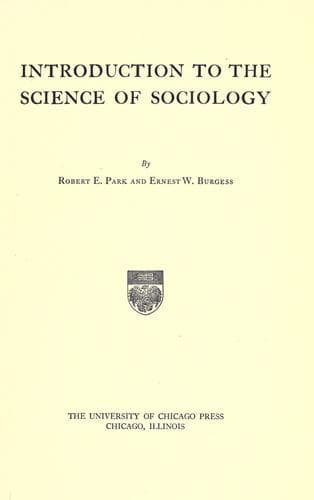
Introduction to the Science of SociologyPark, Robert Ezra
General
Introduction to the Science of Sociology
Park, Robert Ezra
Sociology
If we could list all the traits, each representing some one
characteristic of human nature, and measure the amount of each of them
possessed by a man, we could represent his nature--read his
character--in a great equation. John Smith would equal so many units of
this, plus so many units of that, and so on. Such a mental inventory
would express his individuality conceivably in its entirety and with
great exactitude. No such list has been made for any man, much less have
the exact amounts of each trait possessed by him been measured. But in
certain of the traits, many individuals have been measured; and certain
individuals have been measured, each in a large number of traits.
It is useless to recount the traits in which men have been found to
differ. For there is no trait in which they do not differ. Of course, if
the scale by which individuals are measured is very coarsely divided,
their differences may be hidden. If, for example, ability to learn is
measured on a scale with only two divisions, (1) "ability to learn less
than the average kitten can" and (2) "ability to learn more than the
average kitten can," all men may be put in class two, just as if their
heights were measured on a scale of one yard, two yards, or three yards,
nearly all men would alike be called two yards high. But whenever the
scale of measurement is made fine enough, differences at once appear.
Their existence is indubitable to any impartial observer. The early
psychologists neglected or failed to see them precisely because the
early psychology was partial. It believed in a typical or pattern mind,
after the manner of which all minds were created, and from whom they
differed only by rare accidents. It studied "the mind," and neglected
individual minds. It studied "the will" of "man," neglecting the
interests, impulses, and habits of actual men.
The differences exist at birth and commonly increase with progress
toward maturity. Individuality is already clearly manifest in children
of school age. The same situation evokes widely differing responses; the
same task is done at differing speeds and with different degrees of
success; the same treatment produces differing results. There can be
little doubt that of a thousand ten-year-olds taken at random, some will
be four times as energetic, industrious, quick, courageous, or honest as
others, or will possess four times as much refinement, knowledge of
arithmetic, power of self-control, sympathy, or the like. It has been
found that among children of the same age and, in essential respects, of
the same home training and school advantages, some do in the same time
six times as much, or do the same amount with only one-tenth as many
errors.
B. HUMAN NATURE AND SOCIAL LIFE
1. Human Nature and Its Remaking[65]
Public-domain text, read in full here on John Shaqi.
Reviews
Reviews
No reviews yet
Be the first to share your thoughts on this work.
Elsewhere in the archive
Join the Discussion
Join the discussion
Sign in to leave a comment or review.
Sign InorCreate an account