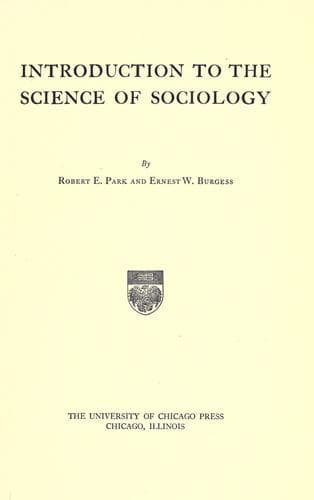
Introduction to the Science of SociologyPark, Robert Ezra
General
Introduction to the Science of Sociology
Park, Robert Ezra
Sociology
In my opinion personality is not merely a unifying and directing
principle which controls thought and action, but one which, at the same
time, defines the relation of individuals to their fellows. The concept
of personality includes, in addition to inner unity and co-ordination of
the impulses, a definite attitude directed toward the outer world which
is determined by the manner in which the individual organizes his
external stimulations.
In this definition the objective aspect of personality is emphasized as
over against the subjective. We should not in psychological matters be
satisfied with subjective definitions. The mental life is not only a sum
of subjective experiences but manifests itself invariably also in a
definite series of objective expressions. These objective expressions
are the contributions which the personality makes to its external social
environment. More than that, only these objective expressions of
personality are accessible to external observation and they alone have
objective value.
According to Ribot, the real personality is an organism which is
represented at its highest in the brain. The brain embraces all our past
and the possibilities of our future. The individual character with all
its active and passive peculiarities, with all its antipathies, genius,
talents, stupidities, virtues, and vices, its inertia and its energy is
predetermined in the brain.
Personality, from the objective point of view, is the psychic individual
with all his original characters, an individual in free association with
his social _milieu_. Neither innate mental ability, nor creative energy,
nor what we call will, in and of themselves, constitutes personality.
Nothing less than the totality of psychical manifestations, all these
including idiosyncrasies which distinguish one man from another and
determine his positive individuality, may be said to characterize, from
the objective point of view, the human personality.
The intellectual horizon of persons on different cultural levels varies,
but no one, for that reason (because of intellectual inferiority), loses
the right to recognition as a person, provided that he maintains, over
against his environment, his integrity as an individual and remains a
self-determining person. It is the loss of this self-determined
individuality alone that renders man completely impersonal. When
individual spontaneity is feebly manifested, we speak of an ill-defined
or a "passive" personality. Personality is, in short, from the objective
point of view, a self-determining individual with a unique nature and a
definite status in the social world around him.
Public-domain text, read in full here on John Shaqi.
Reviews
Reviews
No reviews yet
Be the first to share your thoughts on this work.
Elsewhere in the archive
Join the Discussion
Join the discussion
Sign in to leave a comment or review.
Sign InorCreate an account