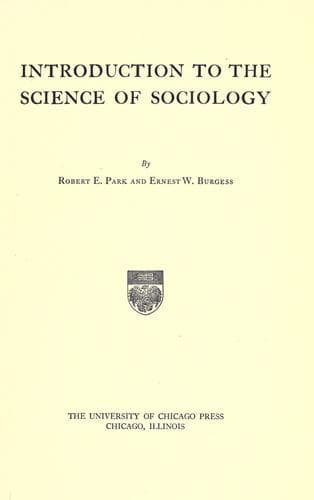
Introduction to the Science of SociologyPark, Robert Ezra
General
Introduction to the Science of Sociology
Park, Robert Ezra
Sociology
If now, on the basis of the preceding definition, we seek to define the
significance of personality in social and public life, it appears that
personality is the basis upon which all social institutions, movements,
and conditions, in short all the phenomena of social life, rest. The
people of our time are no more, as in the Golden Age, inarticulate
masses. They are a totality of more or less active personalities
connected by common interests, in part by racial origin, and by a
certain similarity of fundamental psychic traits. A people is a kind of
collective personality possessing particular ethnic and psychological
characteristics, animated by common political aspirations and political
traditions. The progress of peoples, their civilization, and their
culture naturally are determined by the advancement of the personalities
which compose them. Since the emancipation of mankind from a condition
of subjection, the life of peoples and of societies has rested upon the
active participation of each member of society in the common welfare
which represents the aim of all. The personality, considered as a
psychic self-determining individual, asserts itself the more
energetically in the general march of historical events, the farther a
people is removed from the condition of subjection in which the rights
of personality are denied.
In every field of activity, the more advanced personality "blazes a new
trail." The passive personality, born in subjection, is disposed merely
to imitate and to repeat. The sheer existence of modern states depends
less on the crude physical force and its personified agencies, than on
the moral cohesion of the personalities who constitute the nation.
Since the beginning of time, it is only the moral values that have
endured. Force can support the state only temporarily. When a nation
disregards the moral forces and seeks its salvation in the rude clash of
arms, it bears within itself the seeds of its own destruction. No army
in the world is strong enough to maintain a state, the moral basis of
which is shaken, for the strength of the army rests upon its morale.
Public-domain text, read in full here on John Shaqi.
Reviews
Reviews
No reviews yet
Be the first to share your thoughts on this work.
Elsewhere in the archive
Join the Discussion
Join the discussion
Sign in to leave a comment or review.
Sign InorCreate an account