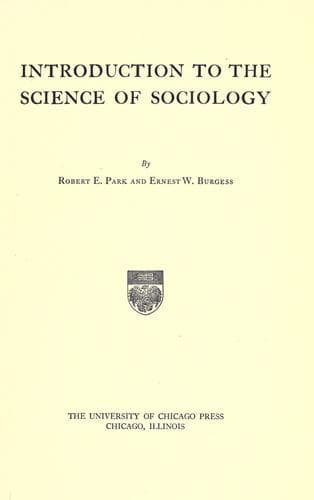
Introduction to the Science of SociologyPark, Robert Ezra
General
Introduction to the Science of Sociology
Park, Robert Ezra
Sociology
The importance of personality in the historic life of peoples is
manifest in periods when social conditions accelerate the movement of
social life. Personality, like every other force, reaches its maximum
when it encounters resistance, in conflict and in rivalry--when it
fights--hence its great value in friendly rivalry of nations in industry
and culture, and especially in periods of natural calamities or of
enemies from without. Since the fruits of individual development
contribute to the common fund of social values, it is clear that
societies and peoples which, other things being equal, possess the most
advanced and active personalities contribute most to the enrichment of
civilization. It does not seem necessary to demonstrate that the pacific
competition of nations and their success depends on the development of
the personalities which compose them. A nation weak in the development
of individualities, of social units which compose it, could not defend
itself against the exploitation of nations composed of personalities
with a superior development.
D. BIOLOGICAL AND SOCIAL HEREDITY
1. Nature and Nurture[75]
We have seen that the scientific position in regard to the
transmissibility of modifications should be one of active scepticism,
that there seems to be no convincing evidence in support of the
affirmative position, and that there is strong presumption in favor of
the negative.
A modification is a definite change in the individual body, due to some
change in "nurture." There is no secure evidence that any such
individual gain or loss can be transmitted as such, or in any
representative degree. How does this affect our estimate of the value of
"nurture"? How should the sceptical or negative answer, which we believe
to be the scientific one, affect our practice in regard to education,
physical culture, amelioration of function, improvement of environment,
and so on? Let us give a practical point to what we have already said.
a) Every inheritance requires an appropriate nurture if it is to
realize itself in development. Nurture supplies the liberating stimuli
necessary for the full expression of the inheritance. A man's character
as well as his physique is a function of "nature" and of "nurture." In
the language of the old parable of the talents, what is given must be
traded with. A boy may be truly enough a chip of the old block, but how
far he shows himself such depends on "nurture." The conditions of
nurture determine whether the expression of the inheritance is to be
full or partial. It need hardly be said that the strength of an
(inherited) individuality may be such that it expresses itself almost in
the face of inappropriate nurture. History abounds in instances. As
Goethe said, "Man is always achieving the impossible." Corot was the son
of a successful milliner and prosperous tradesman, and he was thirty
before he left the draper's shop to study nature.
Public-domain text, read in full here on John Shaqi.
Reviews
Reviews
No reviews yet
Be the first to share your thoughts on this work.
Elsewhere in the archive
Join the Discussion
Join the discussion
Sign in to leave a comment or review.
Sign InorCreate an account