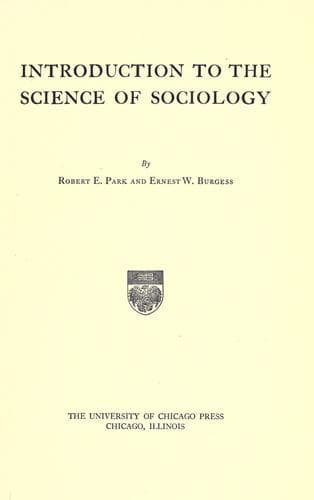
Introduction to the Science of SociologyPark, Robert Ezra
General
Introduction to the Science of Sociology
Park, Robert Ezra
Sociology
13. What evidence is there for the position that sex differences in
mental traits are acquired rather than inborn?
14. How do you distinguish between mentality and temperament?
15. How do you account for the great differences in achievement between
the sexes?
16. What evidence is there of temperamental differences between the
sexes? between races?
17. In the future will women equal men in achievement?
18. What, in your judgment, is the range of individual differences? Is
it less or greater than that of racial and sex differences?
19. What do you understand is the distinction between racial inheritance
as represented by the instincts, and innate individual differences? Do
you think that both should be regarded as part of original nature?
20. What is the effect of education and the division of labor (a) upon
instincts and (b) upon individual differences?
21. Are individual differences or likenesses more important for society?
22. What do you understand to be the significance of individual
differences (a) for social life; (b) for education; (c) for
industry?
23. What do you understand by the remaking of human nature? What is the
importance of this principle for politics, industry, and social
progress?
24. Explain the proverbs: "Habit is ten times nature," "Habit is second
nature."
25. What is Cooley's definition of human nature? Do you agree or
disagree with him? Elaborate your position.
26. To what extent does human nature differ with race and geographic
environment?
27. How would you reinterpret Aristotle's and Hobbes's conception of
human nature in the light of this definition?
28. What illustrations of the difference between folkways and mores
would you suggest?
29. Classify the following forms of behavior under (a) folkways or
(b) mores: tipping the hat, saluting an officer, monogamy, attending
church, Sabbath observance, prohibition, immersion as a form of baptism,
the afternoon tea of the Englishman, the double standard of morals, the
Ten Commandments, the Golden Rule, the Constitution of the United
States.
30. What do you understand to be the relation of the mores to human
nature?
31. In what way is (a) habit related to will? (b) custom related to
the general will?
32. How do you distinguish the general will (a) from law, (b) from
custom?
33. Does any one of the following terms embody your conception of what
is expressed by _Sittlichkeit_: good form, decency, self-respect,
propriety, good breeding, convention?
34. Describe and analyze several concrete social situations where
_Sittlichkeit_ rather than conscience or law controlled the behavior of
the person or of the group.
35. What do you understand by convention? What is the relation of
convention to instinct? Is convention a part of human nature to the same
extent as loyalty, honor, etc.?
36. What is meant by the saying that mores, ritual, and convention are
in the words of Hegel "objective mind"?
Public-domain text, read in full here on John Shaqi.
Reviews
Reviews
No reviews yet
Be the first to share your thoughts on this work.
Elsewhere in the archive
Join the Discussion
Join the discussion
Sign in to leave a comment or review.
Sign InorCreate an account