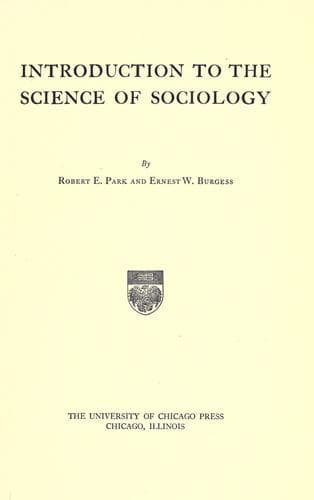
Introduction to the Science of SociologyPark, Robert Ezra
General
Introduction to the Science of Sociology
Park, Robert Ezra
Sociology
37. "The organism, and the brain as its highest representative,
constitute the real personality." What characteristics of personality
are stressed in this definition?
38. Is there any significance to the fact that personality is derived
from the Latin word _persona_ (mask worn by actors)?
39. Is the conventional self a product of habit, or of _Sittlichkeit_,
or of law, or of conscience?
40. What is the importance of other people to the development of
self-consciousness?
41. Under what conditions does self-consciousness arise?
42. What do you understand by personality as a complex? As a total of
mental complexes?
43. What is the relation of memory to personality as illustrated in the
case of dual personality and of moods?
44. What do you understand Cooley to mean by the looking-glass self?
45. What illustration would you suggest to indicate that an individual's
sense of his personality depends upon his status in the group?
46. "All the world's a stage, and all the men and women merely players."
Is personality adequately defined in terms of a person's conception of
his rôle?
47. What is the sociological significance of the saying, "If you would
have a virtue, feign it"?
48. What, according to Bechterew, is the relation of personality to the
social _milieu_?
49. What do you understand by the personality of peoples? What is the
relation of the personality of peoples and the personalities of
individuals who constitute the peoples?
50. What do you understand by the difference between nature and nurture?
51. What are acquired characters? How are they transmitted?
52. What do you understand by the Mendelian principles of inheritance:
(a) the hypothesis of unit characters; (b) the law of dominance; and
(c) the law of segregation?
53. What illustrations of the differences between instinct and tradition
would you suggest?
54. What is the difference between the blue eye as a defect in
pigmentation, and of feeble-mindedness as a defective characteristic?
55. Should it be the policy of society to eliminate all members below a
certain mental level either by segregation or by more drastic measures?
56. What principles of treatment of practical value to parents and
teachers would you draw from the fact that feeble inhibition of temper
is a trait transmitted by biological inheritance?
57. Why is an understanding of the principles of biological inheritance
of importance to sociology?
58. In what two ways, according to Keller, are acquired characters
transmitted by tradition?
59. Make a list of the different types of things derived by the person
(a) from his biological inheritance, and (b) from his social
heritage.
60. What traits, temperament, mentality, manner, or character, are
distinctive of members of your family? Which of these have been
inherited, which acquired?
61. What problems in society are due to defects in man's original
nature?
62. What problems are the result of defects in folkways and mores?
Public-domain text, read in full here on John Shaqi.
Reviews
Reviews
No reviews yet
Be the first to share your thoughts on this work.
Elsewhere in the archive
Join the Discussion
Join the discussion
Sign in to leave a comment or review.
Sign InorCreate an account