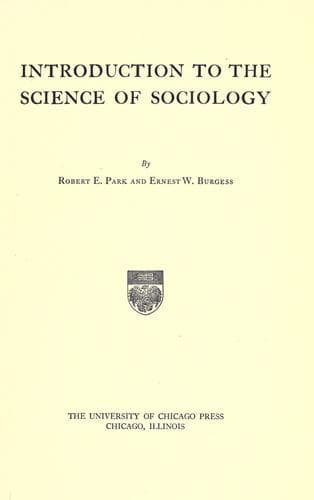
Introduction to the Science of SociologyPark, Robert Ezra
General
Introduction to the Science of Sociology
Park, Robert Ezra
Sociology
concerns itself with, and the standard determining the claim is the
custom of the country.
In human society, then, the conditions regulating conduct are from the
first greatly modified. Instinct, becoming vague and more general, has
evolved into "character," while the intelligence finds itself confronted
with customs to which it has to accommodate conduct. But how does custom
arise? Let us first consider what custom is. It is not merely a habit of
action; but it implies also a judgment upon action, and a judgment
stated in general and impersonal terms. It would seem to imply a
bystander or third party. If A hits B, B probably hits back. It is his
"habit" so to do. But if C, looking on, pronounces that it was or was
not a fair blow, he will probably appeal to the "custom" of the
country--the traditional rules of fighting, for instance--as the ground
of his judgment. That is, he will lay down a rule which is general in
the sense that it would apply to other individuals under similar
conditions, and by it he will, as an impartial third person, appraise
the conduct of the contending parties. The formation of such rules,
resting as it does on the power of framing and applying general
conceptions, is the prime differentia of human morality from animal
behavior. The fact that they arise and are handed on from generation to
generation makes social tradition at once the dominating factor in the
regulation of human conduct. Without such rules we can scarcely conceive
society to exist, since it is only through the general conformity to
custom that men can understand each other, that each can know how the
other will act under given circumstances, and without this amount of
understanding the reciprocity, which is the vital principle of society,
disappears.
4. Collective Representation and Intellectual Life[89]
Logical thought is made up of concepts. Seeking how society can have
played a rôle in the genesis of logical thought thus reduces itself to
seeking how it can have taken a part in the formation of concepts.
The concept is opposed to sensual representations of every
order--sensations, perceptions, or images--by the following properties.
Public-domain text, read in full here on John Shaqi.
Reviews
Reviews
No reviews yet
Be the first to share your thoughts on this work.
Elsewhere in the archive
Join the Discussion
Join the discussion
Sign in to leave a comment or review.
Sign InorCreate an account