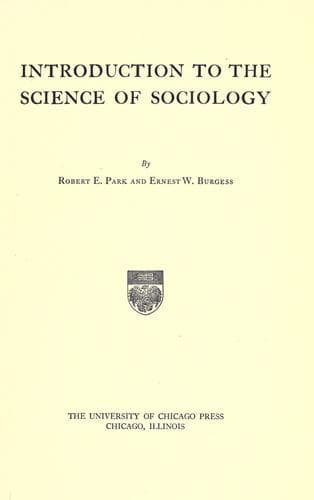
Introduction to the Science of SociologyPark, Robert Ezra
General
Introduction to the Science of Sociology
Park, Robert Ezra
Sociology
Sensual representations are in a perpetual flux; they come after each
other like the waves of a river, and even during the time that they last
they do not remain the same thing. Each of them is an integral part of
the precise instant when it takes place. We are never sure of again
finding a perception such as we experienced it the first time; for if
the thing perceived has not changed, it is we who are no longer the
same. On the contrary, the concept is, as it were, outside of time and
change; it is in the depths below all this agitation; it might be said
that it is in a different portion of the mind, which is serener and
calmer. It does not move of itself, by an internal and spontaneous
evolution, but, on the contrary, it resists change. It is a manner of
thinking that, at every moment of time, is fixed and crystallized. In so
far as it is what it ought to be, it is immutable. If it changes, it is
not because it is its nature to do so, but because we have discovered
some imperfection in it; it is because it had to be rectified. The
system of concepts with which we think in everyday life is that
expressed by the vocabulary of our mother-tongue; for every word
translates a concept. Now language is something fixed; it changes but
very slowly, and consequently it is the same with the conceptual system
which it expresses. The scholar finds himself in the same situation in
regard to the special terminology employed by the science to which he
has consecrated himself, and hence in regard to the special scheme of
concepts to which this terminology corresponds. It is true that he can
make innovations, but these are always a sort of violence done to the
established ways of thinking.
And at the same time that it is relatively immutable, the concept is
universal, or at least capable of becoming so. A concept is not my
concept; I hold it in common with other men, or, in any case, can
communicate it to them. It is impossible for me to make a sensation pass
from my consciousness into that of another; it holds closely to my
organism and personality and cannot be detached from them. All that I
can do is to invite others to place themselves before the same object as
myself and to leave themselves to its action. On the other hand,
conversation and all intellectual communication between men is an
exchange of concepts. The concept is an essentially impersonal
representation; it is through it that human intelligences communicate.
Public-domain text, read in full here on John Shaqi.
Reviews
Reviews
No reviews yet
Be the first to share your thoughts on this work.
Elsewhere in the archive
Join the Discussion
Join the discussion
Sign in to leave a comment or review.
Sign InorCreate an account