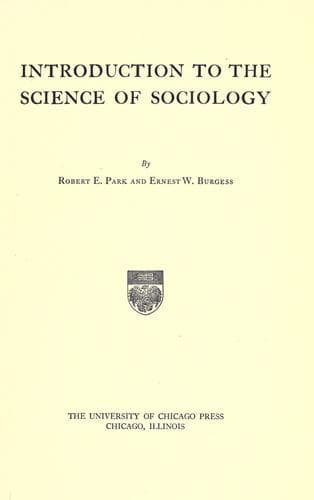
Introduction to the Science of SociologyPark, Robert Ezra
General
Introduction to the Science of Sociology
Park, Robert Ezra
Sociology
Whatever social problem we confront, whatever persons come into our
field of view, the first questions involved will always be: To what
groups do these persons belong? What are the interests of these groups?
What sort of means do the groups use to promote their interests? How
strong are these groups, as compared with groups that have conflicting
interests? These questions go to one tap root of all social
interpretation, whether in the case of historical events far in the
past, or of the most practical problems of our own neighborhood.
2. The Unity of the Social Group[91]
It has long been a cardinal problem in sociology to determine just how
to conceive in objective terms so very real and palpable a thing as the
continuity and persistence of social groups. Looked at as a physical
object society appears to be made up of mobile and independent units.
The problem is to understand the nature of the bonds that bind these
independent units together and how these connections are maintained and
transmitted.
Conceived of in its lowest terms the unity of the social group may be
compared to that of the plant communities. In these communities, the
relation between the individual species which compose it seems at first
wholly fortuitous and external. Co-operation and community, so far as it
exists, consists merely in the fact that within a given geographical
area, certain species come together merely because each happens to
provide by its presence an environment in which the life of the other is
easier, more secure, than if they lived in isolation. It seems to be a
fact, however, that this communal life of the associated plants fulfils,
as in other forms of life, a typical series of changes which correspond
to growth, decay and death. The plant community comes into existence,
matures, grows old, and eventually dies. In doing this, however, it
provides by its own death an environment in which another form of
community finds its natural habitat. Each community thus precedes and
prepares the way for its successor. Under such circumstances the
succession of the individual communities itself assumes the character of
a life-process.
In the case of the animal and human societies we have all these
conditions and forces and something more. The individuals associated in
an animal community not only provide, each for the other, a physical
environment in which all may live, but the members of the community are
organically pre-adapted to one another in ways which are not
characteristic of the members of a plant community. As a consequence,
the relations between the members of the animal community assume a much
more organic character. It is, in fact, a characteristic of animal
society that the members of a social group are organically adapted to
one another and therefore the organization of animal society is almost
wholly transmitted by physical inheritance.
Public-domain text, read in full here on John Shaqi.
Reviews
Reviews
No reviews yet
Be the first to share your thoughts on this work.
Elsewhere in the archive
Join the Discussion
Join the discussion
Sign in to leave a comment or review.
Sign InorCreate an account