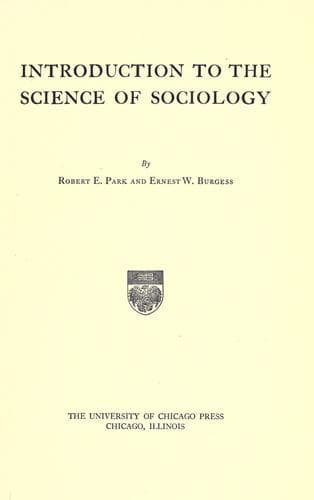
Introduction to the Science of SociologyPark, Robert Ezra
General
Introduction to the Science of Sociology
Park, Robert Ezra
Sociology
In the case of human societies we discover not merely organically
inherited adaptation, which characterizes animal societies, but, in
addition, a great body of habits and accommodations which are
transmitted in the form of social inheritance. Something that
corresponds to social tradition exists, to be sure, in animal societies.
Animals learn by imitation from one another, and there is evidence that
this social tradition varies with changes in environment. In man,
however, association is based on something more than habits or instinct.
In human society, largely as a result of language, there exists a
conscious community of purpose. We have not merely folkways, which by an
extension of that term might be attributed to animals, but we have mores
and formal standards of conduct.
In a recent notable volume on education, John Dewey has formulated a
definition of the educational process which he identifies with the
process by which the social tradition of human society is transmitted.
Education, he says in effect, is a self-renewing process, a process in
which and through which the social organism lives.
With the renewal of physical existence goes, in the case of
human beings, the re-creation of beliefs, ideals, hopes,
happiness, misery and practices. The continuity of experience,
through renewal of the social group, is a literal fact.
Education, in its broadest sense, is the means of this social
continuity of life.
Under ordinary circumstances the transmission of the social tradition is
from the parents to the children. Children are born into the society and
take over its customs, habits, and standards of life simply, naturally,
and without conflict. But it will at once occur to anyone that the
physical life of society is not always continued and maintained in this
natural way, i.e., by the succession of parents and children. New
societies are formed by conquest and by the imposition of one people
upon another. In such cases there arises a conflict of cultures, and as
a result the process of fusion takes place slowly and is frequently not
complete. New societies are frequently formed by colonization, in which
case new cultures are grafted on to older ones. The work of missionary
societies is essentially one of colonization in this sense. Finally we
have societies growing up, as in the United States, by immigration.
These immigrants, coming as they do from all parts of the world, bring
with them fragments of divergent cultures. Here again the process of
assimilation is slow, often painful, not always complete.
3. Types of Social Groups[92]
Between the two extreme poles--the crowd and the state (nation)--between
these extreme links of the chain of human association, what are the
other intermediate groups, and what are their distinctive
characteristics?
Gustave Le Bon thus classifies the different types of crowds
(aggregations):
Public-domain text, read in full here on John Shaqi.
Reviews
Reviews
No reviews yet
Be the first to share your thoughts on this work.
Elsewhere in the archive
Join the Discussion
Join the discussion
Sign in to leave a comment or review.
Sign InorCreate an account