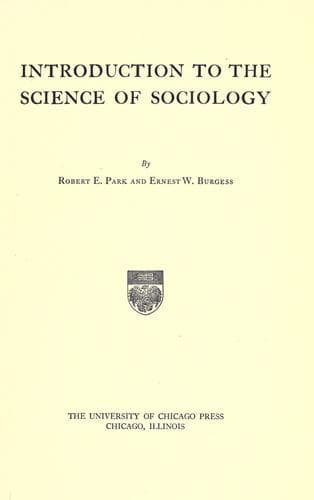
Introduction to the Science of SociologyPark, Robert Ezra
General
Introduction to the Science of Sociology
Park, Robert Ezra
Sociology
A. Heterogeneous crowds
1. Anonymous (street crowds, for example)
2. Not anonymous (parliamentary assemblies, for example)
B. Homogeneous crowds
1. Sects (political, religious, etc.)
2. Castes (military, sacerdotal, etc.)
3. Classes (bourgeois, working-men, etc.)
This classification is open to criticism. First of all, it is inaccurate
to give the name of crowd indiscriminately to every human group.
Literally (from the etymological standpoint) this objection seems to me
unanswerable. Tarde more exactly distinguishes between crowds,
associations, and corporations.
But we retain the generic term of "crowd" because it indicates the first
stage of the social group which is the source of all the others, and
because with these successive distinctions it does not lend itself to
equivocal meaning.
In the second place, it is difficult to understand why Le Bon terms the
sect a _homogeneous_ crowd, while he classifies parliamentary assemblies
among the _heterogeneous_ crowds. The members of a sect are usually far
more different from one another in birth, education, profession, social
status, than are generally the members of a political assembly.
Turning from this criticism to note without analyzing heterogeneous
crowds, let us then proceed to determine the principal characteristics
of the three large types of homogeneous crowds, the classes, the castes,
the sects.
The heterogeneous crowd is composed of _tout le monde_, of people like
you, like me, like the first passer-by. _Chance_ unites these
individuals physically, the _occasion_ unites them psychologically; they
do not know each other, and after the moment when they find themselves
together, they may never see each other again. To use a metaphor, it is
a psychological meteor, of the most unforeseen, ephemeral, and
transitory kind.
On this accidental and fortuitous foundation are formed here and there
other crowds, always heterogeneous, but with a certain character of
stability or, at least, of periodicity. The audience at a theater, the
members of a club, of a literary or social gathering, constitute also a
crowd but a different crowd from that of the street. The members of
these groups know each other a little; they have, if not a common aim,
at least a common custom. They are nevertheless "anonymous crowds," as
Le Bon calls them, because they do not have within themselves the
nucleus of organization.
Public-domain text, read in full here on John Shaqi.
Reviews
Reviews
No reviews yet
Be the first to share your thoughts on this work.
Elsewhere in the archive
Join the Discussion
Join the discussion
Sign in to leave a comment or review.
Sign InorCreate an account