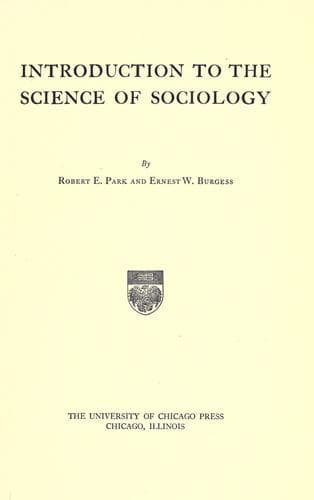
Introduction to the Science of SociologyPark, Robert Ezra
General
Introduction to the Science of Sociology
Park, Robert Ezra
Sociology
Relations of persons with persons, and of groups with groups, may be
either those of isolation or those of contact. The emphasis in this
chapter is placed upon _isolation_, in the next chapter upon _contact_
in a comparison of their effects upon personal conduct and group
behavior.
Absolute isolation of the person from the members of his group is
unthinkable. Even biologically, two individuals of the higher animal
species are the precondition to a new individual existence. In man,
postnatal care by the parent for five or six years is necessary even for
the physiological survival of the offspring. Not only biologically but
sociologically complete isolation is a contradiction in terms.
Sociologists following Aristotle have agreed with him that human nature
develops within and decays outside of social relations. Isolation, then,
in the social as well as the biological sense is _relative_, not
_absolute_.
The term "isolation" was first employed in anthropogeography, the study
of the relation of man to his physical environment. To natural barriers,
as mountains, oceans, and deserts, was attributed an influence upon the
location of races and the movements of peoples and the kind and the
degree of cultural contact. The nature and the extent of separation of
persons and groups was considered by geographers as a reflex of the
physical environment.
In biology, isolation as a factor in the evolution and the life of the
species, is studied from the standpoint of the animal group more than
from that of the environment. Consequently, the separation of species
from each other is regarded as the outcome not only of a sheer physical
impossibility of contact, but even more of other factors as differences
in physical structure, in habits of life, and in the instincts of the
animal groups. J. Arthur Thomson in his work on "Heredity" presents the
following compact and illuminating statement of isolation as a factor in
inheritance.
The only other directive evolution-factor that biologists are
at all agreed about, besides selection, is isolation--a general
term for all the varied ways in which the radius of possible
intercrossing is narrowed. As expounded by Wagner, Weismann,
Romanes, Gulick, and others, isolation takes many
forms--spatial, structural, habitudinal, and psychical--and it
has various results.
Public-domain text, read in full here on John Shaqi.
Reviews
Reviews
No reviews yet
Be the first to share your thoughts on this work.
Elsewhere in the archive
Join the Discussion
Join the discussion
Sign in to leave a comment or review.
Sign InorCreate an account