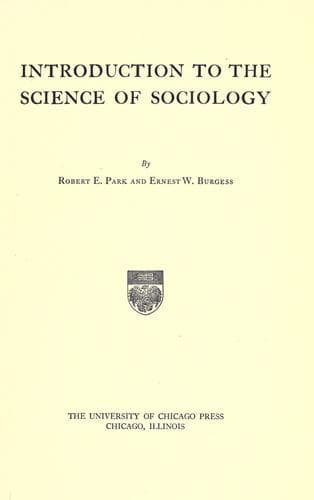
Introduction to the Science of SociologyPark, Robert Ezra
General
Introduction to the Science of Sociology
Park, Robert Ezra
Sociology
30. What groups are omitted in Le Bon's classification of social groups?
Make a list of all the groups, formal and informal, of which you are a
member. Arrange these groups under the classification given in the
General Introduction (p. 50). Compare this classification with that made
by Le Bon.
31. How do you distinguish between _esprit de corps_, morale, and
collective representation as forms of consensus?
32. Classify under _esprit de corps_, morale, or collective
representation the following aspects of group behavior: rooting at a
football game; army discipline; the flag; college spirit; the so-called
"war psychosis"; the fourteen points of President Wilson; "the English
never know when they are beaten"; slogans; "Paris refrains from
exultation"; crowd enthusiasm; the Golden Rule; "where there's a will
there's a way"; Grant's determination, "I'll fight it out this way if it
takes all summer"; ideals.
33. "The human mind has a large capacity for adopting beliefs that fit
the trends of its habits and feelings." Give concrete illustrations
outside of army life.
34. What is the importance of the study of the family as a social
group?
FOOTNOTES:
[80] See _supra_, chap. i, pp. 50-51.
[81] Translated from Alfred Espinas, _Des sociétés animales_ (1878), pp.
157-60.
[82] Adapted from William M. Wheeler, _Ants, Their Structure,
Development, Behavior_, pp. 339-424. (Columbia University Press, 1910.)
[83] Adapted from P. Chalmers Mitchell, _The Childhood of Animals_, pp.
204-21. (Frederick A. Stokes & Co., 1912.)
[84] Adapted from Eugenius Warming, _Oecology of Plants_, pp. 12-13,
91-95. (Oxford University Press, 1909.)
[85] Adapted from William E. Wheeler, _Ants, Their Structure,
Development, and Behavior_, pp. 5-7. (Columbia University Press, 1910.)
[86] From John Dewey, _Democracy and Education_, pp. 1-7. (Published by
The Macmillan Co., 1916. Reprinted by permission.)
[87] From Robert E. Park, _Principles of Human Behavior_, pp. 1-9. (The
Zalaz Corporation, 1915.)
[88] Adapted from L. T. Hobhouse, _Morals in Evolution_, pp. 1-2, 10-12.
(Henry Holt & Co., 1915.)
[89] Adapted from Émile Durkheim, _Elementary Forms of Religious Life_,
pp. 432-37. (Allen & Unwin, 1915.)
[90] From Albion W. Small, _General Sociology_, pp. 495-97. (The
University of Chicago Press, 1905.)
[91] From R. E. Park, "Education in Its Relation to the Conflict and
Fusion of Cultures," in the _Publications of the American Sociological
Society_, VIII (1918), 38-40.
[92] Translated from S. Sighele, _Psychologie des Sectes_, pp. 42-51.
(M. Giard et Cie., 1898.)
[93] Adapted from William E. Hocking, _Morale and Its Enemies_, pp.
3-37. (Yale University Press, 1918.)
CHAPTER IV
I. INTRODUCTION
1. Geological and Biological Conceptions of Isolation
Public-domain text, read in full here on John Shaqi.
Reviews
Reviews
No reviews yet
Be the first to share your thoughts on this work.
Elsewhere in the archive
Join the Discussion
Join the discussion
Sign in to leave a comment or review.
Sign InorCreate an account