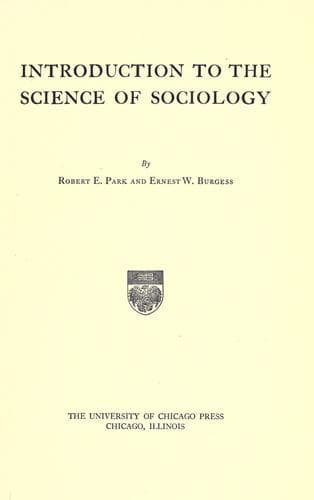
Introduction to the Science of SociologyPark, Robert Ezra
General
Introduction to the Science of Sociology
Park, Robert Ezra
Sociology
All this suggests the intimate relations which exist between history,
politics, and sociology. The important thing, however, is not the
identities but the distinctions. For, however much the various
disciplines may, in practice, overlap, it is necessary for the sake of
clear thinking to have their limits defined. As far as sociology and
history are concerned the differences may be summed up in a word. Both
history and sociology are concerned with the life of man as man.
History, however, seeks to reproduce and interpret concrete events as
they actually occurred in time and space. Sociology, on the other hand,
seeks to arrive at natural laws and generalizations in regard to human
nature and society, irrespective of time and of place.
In other words, history seeks to find out what actually happened and how
it all came about. Sociology, on the other hand, seeks to explain, on
the basis of a study of other instances, the nature of the process
involved.
By nature we mean just that aspect and character of things in regard to
which it is possible to make general statements and formulate laws. If
we say, in explanation of the peculiar behavior of some individual, that
it is natural or that it is after all "simply human nature," we are
simply saying that this behavior is what we have learned to expect of
this individual or of human beings in general. It is, in other words, a
law.
Natural law, as the term is used here, is any statement which describes
the behavior of a class of objects or the character of a class of acts.
For example, the classic illustration of the so-called "universal
proposition" familiar to students of formal logic, "all men are mortal,"
is an assertion in regard to a class of objects we call men. This is, of
course, simply a more formal way of saying that "men die." Such general
statements and "laws" get meaning only when they are applied to
particular cases, or, to speak again in the terms of formal logic, when
they find a place in a syllogism, thus: "Men are mortal. This is a
man." But such syllogisms may always be stated in the form of a
hypothesis. If this is a man, he is mortal. If a is b, a is also
c. This statement, "Human nature is a product of social contact," is a
general assertion familiar to students of sociology. This law or, more
correctly, hypothesis, applied to an individual case explains the
so-called feral man. Wild men, in the proper sense of the word, are not
the so-called savages, but the men who have never been domesticated, of
which an individual example is now and then discovered.
To state a law in the form of a hypothesis serves to emphasize the fact
that laws--what we have called natural laws at any rate--are subject to
verification and restatement. Under the circumstances the exceptional
instance, which compels a restatement of the hypothesis, is more
important for the purposes of science than other instances which merely
confirm it.
Public-domain text, read in full here on John Shaqi.
Reviews
Reviews
No reviews yet
Be the first to share your thoughts on this work.
Join the Discussion
Join the discussion
Sign in to leave a comment or review.
Sign InorCreate an account