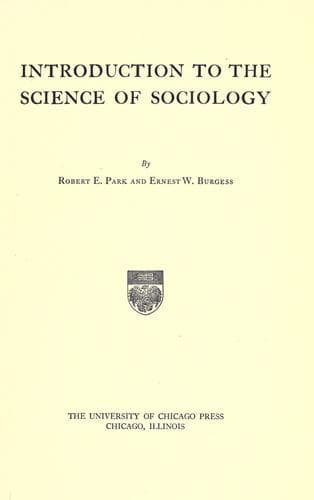
Introduction to the Science of SociologyPark, Robert Ezra
General
Introduction to the Science of Sociology
Park, Robert Ezra
Sociology
Just as the life of the family represents the contacts of touch and
response, the neighborhood or the village is the natural area of primary
contacts and the city the social environment of secondary contacts. In
primary association individuals are in contact with each other at
practically all points of their lives. In the village "everyone knows
everything about everyone else." Canons of conduct are absolute, social
control is omnipotent, the status of the family and the individual is
fixed. In secondary association individuals are in contact with each
other at only one or two points in their lives. In the city, the
individual becomes anonymous; at best he is generally known in only one
or two aspects of his life. Standards of behavior are relative; the old
primary controls have disappeared; the new secondary instruments of
discipline, necessarily formal, are for the most part crude and
inefficient; the standing of the family and of the individual is
uncertain and subject to abrupt changes upward or downward in the social
scale.
Simmel has made a brilliant contribution in his analysis of the
sociological significance of "the stranger." "The stranger" in the
sociological sense is the individual who unites in his social relations
primary and secondary contacts. Simmel himself employs the conception of
social distance in his statement of the stranger as the combination of
the near and the far. It is interesting and significant to determine the
different types of the union of intimacy and externality in the
relations of teacher and student, physician and patient, minister and
layman, lawyer and client, social worker and applicant for relief.
A complete analysis of the bearing upon personal and cultural life of
changes from a society based upon contacts of continuity and of primary
relations to a society of increasing mobility organized around secondary
contacts cannot be given here. Certain of the most obvious contrasts of
the transition may, however, be stated. Increasing mobility of persons
in society almost inevitably leads to change and therefore to loss of
continuity. In primary groups, where social life moves slowly, there is
a greater sense of continuity than in secondary groups where it moves
rapidly.
Public-domain text, read in full here on John Shaqi.
Reviews
Reviews
No reviews yet
Be the first to share your thoughts on this work.
Elsewhere in the archive
Join the Discussion
Join the discussion
Sign in to leave a comment or review.
Sign InorCreate an account