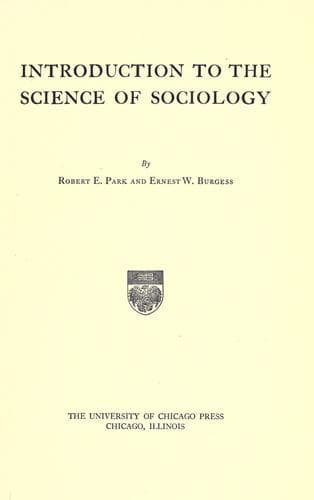
Introduction to the Science of SociologyPark, Robert Ezra
General
Introduction to the Science of Sociology
Park, Robert Ezra
Sociology
There is a further contrast if not conflict between direct and intimate
contacts and contacts based upon communication of ideas. All sense of
values, as Windelband has pointed out,[119] rests upon concrete
experience, that is to say upon sense contacts. Society, to the extent
that it is organized about secondary contacts, is based upon
abstractions, upon science and technique. Secondary contacts of this
type have only secondary values because they represent means rather than
ends. Just as all behavior arises in sense impressions it must also
terminate in sense impressions to realize its ends and attain its
values. The effect of life in a society based on secondary contacts is
to build up between the impulse and its end a world of means, to project
values into the future, and to direct life toward the realization of
distant hopes.
The ultimate effect upon the individual as he becomes accommodated to
secondary society is to find a substitute expression for his primary
response in the artificial physical environment of the city. The
detachment of the person from intimate, direct, and spontaneous contacts
with social reality is in large measure responsible for the intricate
maze of problems of urban life.
The change from concrete and personal to abstract and impersonal
relations in economic and social life began with the Industrial
Revolution. The machine is the symbol of the monotonous routine of
impersonal, unskilled, large-scale production just as the hand tool is
the token of the interesting activity of personal, skilled, handicraft
work. The so-called "instinct of workmanship" no longer finds expression
in the anonymous standardized production of modern industry.[120]
It is not in industry alone that the natural impulses of the person for
response, recognition, and self-expression are balked. In social work,
politics, religion, art, and sport the individual is represented now by
proxies where formerly he participated in person. All the forms of
communal activity in which all persons formerly shared have been taken
over by professionals. The great mass of men in most of the social
activities of modern life are no longer actors, but spectators. The
average man of the present time has been relegated by the influence of
the professional politician to the rôle of taxpayer. In social work
organized charity has come between the giver and the needy.
Public-domain text, read in full here on John Shaqi.
Reviews
Reviews
No reviews yet
Be the first to share your thoughts on this work.
Elsewhere in the archive
Join the Discussion
Join the discussion
Sign in to leave a comment or review.
Sign InorCreate an account