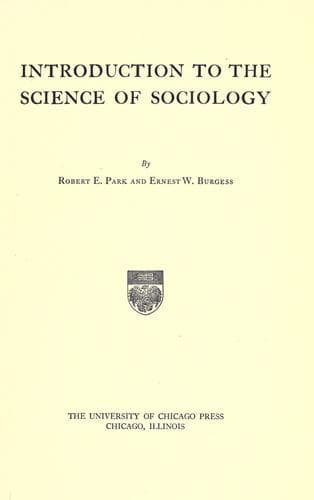
Introduction to the Science of SociologyPark, Robert Ezra
General
Introduction to the Science of Sociology
Park, Robert Ezra
Sociology
Since, as a matter of fact, cultural resemblances abound
between peoples of diverse stock, their interpretation commonly
narrows to a choice between two alternatives. Either they are
due to like causes, whether these can be determined or not; or
they are the result of borrowing. A predilection for one or the
other explanation has lain at the bottom of much ethnological
discussion in the past; and at present influential schools both
in England and in continental Europe clamorously insist that
all cultural parallels are due to diffusion from a single
center. It is inevitable to envisage this moot-problem at the
start, since uncompromising championship of either alternative
has far-reaching practical consequences. For if every parallel
is due to borrowing, then sociological laws, which can be
inferred only from independently developing likenesses, are
barred. Then the history of religion or social life or
technology consists exclusively in a statement of the place of
origin of beliefs, customs and implements, and a recital of
their travels to different parts of the globe. On the other
hand, if borrowing covers only part of the observed parallels,
an explanation from like causes becomes at least the ideal goal
in an investigation of the remainder.[20]
An illustration will exhibit the manner in which problems originally
historical become psychological and sociological. Tyler in his _Early
History of Mankind_ has pointed out that the bellows used by the negro
blacksmiths of continental Africa are of a quite different type from
those used by natives of Madagascar. The bellows used by the Madagascar
blacksmiths, on the other hand, are exactly like those in use by the
Malays of Sumatra and in other parts of the Malay Archipelago. This
indication that the natives of Madagascar are of Malay origin is in
accordance with other anthropological and ethnological data in regard to
these peoples, which prove the fact, now well established, that they are
not of African origin.
Similarly Boas' study of the Raven cycle of American Indian mythology
indicated that these stories originated in the northern part of British
Columbia and traveled southward along the coast. One of the evidences
of the direction of this progress is the gradual diminution of
complexity in the stories as they traveled into regions farther removed
from the point of origin.
All this, in so far as it seeks to determine the point of origin,
direction, speed, and character of changes that take place in cultural
materials in the process of diffusion, is clearly history and ethnology.
Public-domain text, read in full here on John Shaqi.
Reviews
Reviews
No reviews yet
Be the first to share your thoughts on this work.
Join the Discussion
Join the discussion
Sign in to leave a comment or review.
Sign InorCreate an account