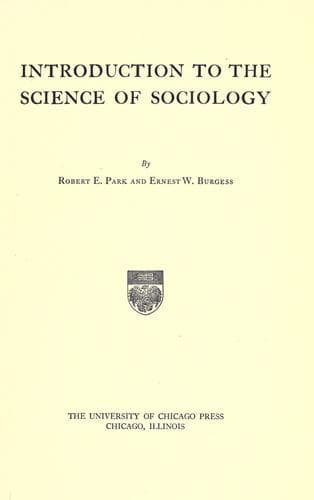
Introduction to the Science of Sociology — John Shaqi
Introduction to the Science of SociologyPark, Robert Ezra
General
Introduction to the Science of Sociology
Park, Robert Ezra
Sociology
It seems hard to maintain that the change in a syntactical
construction or in the meaning of a word owes its universality
to a simultaneous and independent primary change in all the
members of a speech-community. By adopting the theory of
imitative spread, all linguistic changes may be viewed as one
homogeneous whole. In the second place, the latter view seems
to bring linguistic changes into line with the other social
changes, such as modifications in institutions, beliefs, and
customs. For is it not an essential characteristic of a social
group that its members are not co-operative in the sense that
each member actively participates in the production of every
single element which goes to make up either language, or
belief, or customs? Distinguishing thus between _primary_ and
_secondary_ changes and between the _origin_ of a change and
its _spread_, it behooves us to examine carefully into the
causes which make the members of a social unit, either
consciously or unconsciously, willing to accept the innovation.
What is it that determines acceptance or rejection of a
particular change? What limits one change to a small area,
while it extends the area of another? Before a final decision
can be reached in favor of the second theory of imitative
spread it will be necessary to follow out in minute detail the
mechanism of this process in a number of concrete instances; in
other words to fill out the picture of which Tarde (_Les lois
de l'imitation_) sketched the bare outlines. If his assumptions
prove true, then we should have here a uniformity resting upon
other causes than the physical uniformity that appears in the
objects with which the natural sciences deal. It would enable
us to establish a second group of uniform phenomena which is
psycho-physical in its character and rests upon the basis of
social suggestion. The uniformities in speech, belief, and
institutions would belong to this second group.[23]
Public-domain text, read in full here on John Shaqi.
Reviews
Reviews
No reviews yet
Be the first to share your thoughts on this work.
Join the Discussion
Join the discussion
Sign in to leave a comment or review.
Sign InorCreate an account