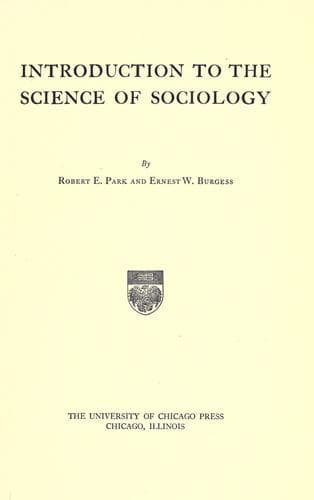
Introduction to the Science of SociologyPark, Robert Ezra
General
Introduction to the Science of Sociology
Park, Robert Ezra
Sociology
Spencer's manner of looking at the social organism may be illustrated in
what he says about growth in "social aggregates."
When we say that growth is common to social aggregates and
organic aggregates, we do not thus entirely exclude community
with inorganic aggregates. Some of these, as crystals, grow in
a visible manner; and all of them on the hypothesis of
evolution, have arisen by integration at some time or other.
Nevertheless, compared with things we call inanimate, living
bodies and societies so conspicuously exhibit augmentation of
mass, that we may fairly regard this as characterizing them
both. Many organisms grow throughout their lives; and the rest
grow throughout considerable parts of their lives. Social
growth usually continues either up to times when the societies
divide, or up to times when they are overwhelmed.
Here, then, is the first trait by which societies ally
themselves with the organic world and substantially distinguish
themselves from the inorganic world.[28]
In this same way, comparing the characteristic general features of
"social" and "living bodies," noting likeness and differences,
particularly with reference to complexity of structure, differentiation
of function, division of labor, etc., Spencer gives a perfectly
naturalistic account of the characteristic identities and differences
between societies and animals, between sociological and biological
organizations. It is in respect to the division of labor that the
analogy between societies and animals goes farthest and is most
significant.
This division of labour, first dwelt upon by political
economists as a social phenomenon, and thereupon recognized by
biologists as a phenomenon of living bodies, which they called
the "physiological division of labour," is that which in the
society, as in the animal, makes it a living whole. Scarcely
can I emphasize enough the truth that in respect of this
fundamental trait, a social organism and an individual organism
are entirely alike.[29]
The "social aggregate," although it is "discrete" instead of
"concrete"--that is to say, composed of spatially separated units--is
nevertheless, because of the mutual dependence of these units upon one
another as exhibited in the division of labor, to be regarded as a
living whole. It is "a living whole" in much the same way that the plant
and animal communities, of which the ecologists are now writing so
interestingly, are a living whole; not because of any intrinsic
relations between the individuals who compose them, but because each
individual member of the community, finds in the community as a whole, a
suitable milieu, an environment adapted to his needs and one to which he
is able to adapt himself.
Public-domain text, read in full here on John Shaqi.
Reviews
Reviews
No reviews yet
Be the first to share your thoughts on this work.
Join the Discussion
Join the discussion
Sign in to leave a comment or review.
Sign InorCreate an account