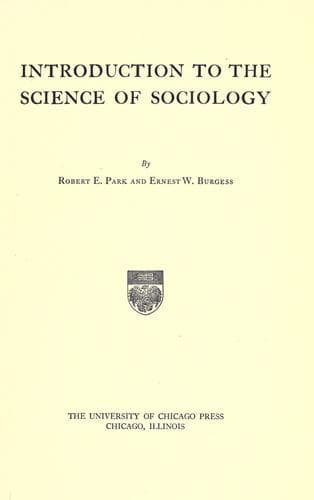
Introduction to the Science of SociologyPark, Robert Ezra
General
Introduction to the Science of Sociology
Park, Robert Ezra
Sociology
A typical reflex, or instinct, or capacity, as a whole, includes the
ability to be sensitive to a certain situation, the ability to make a
certain response, and the existence of a bond or connection whereby that
response is made to that situation. For instance, the young chick is
sensitive to the absence of other members of his species, is able to
peep, and is so organized that the absence of other members of the
species makes him peep. But the tendency to be sensitive to a certain
situation may exist without the existence of a connection therewith of
any further exclusive response, and the tendency to make a certain
response may exist without the existence of a connection limiting that
response exclusively to any single situation. The three-year-old child
is by inborn nature markedly sensitive to the presence and acts of other
human beings, but the exact nature of his response varies. The original
tendency to cry is very strong, but there is no one situation to which
it is exclusively bound. Original nature seems to decide that the
individual will respond somehow to certain situations more often than it
decides just what he will do, and to decide that he will make certain
responses more often than it decides just when he will make them. So,
for convenience in thinking about man's unlearned equipment, this
appearance of _multiple response_ to one same situation and _multiple
causation_ of one same response may be taken roughly as the fact.
2. Inventory of Original Tendencies[59]
I. _Sensory capacities_
II. _Original attentiveness_
III. _Gross bodily control_
IV. _Food getting and habitation_
A. Food getting
1. Eating. 2. Reaching, grasping, putting into the mouth.
3. Acquisition and possession. 4. Hunting (a) a small
escaping object, (b) a small or moderate-sized object not of
offensive mien, moving away from or past him. 5. Possible
specialized tendencies. 6. Collecting and hoarding.
7. Avoidance and repulsion. 8. Rivalry and co-operation
B. Habitation
1. Responses to confinement. 2. Migration and domesticity
V. _Fear, fighting, and anger_
A. Fear
1. Unpleasant expectation and dread. 2. Anxiety and
worry. 3. Dislike and avoidance. 4. Shock. 5. Flight,
paralysis, etc.
B. Fighting
1. Escape from restraint. 2. Overcoming a moving obstacle.
3. Counter-attack. 4. Irrational response to pain.
5. Combat in rivalry. 6. Resentment of presence of other
males in courtship. 7. Angry behavior at persistent
thwarting.
C. Anger
Public-domain text, read in full here on John Shaqi.
Reviews
Reviews
No reviews yet
Be the first to share your thoughts on this work.
Elsewhere in the archive
Join the Discussion
Join the discussion
Sign in to leave a comment or review.
Sign InorCreate an account