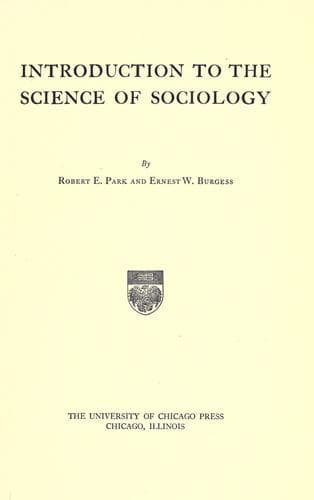
Introduction to the Science of SociologyPark, Robert Ezra
General
Introduction to the Science of Sociology
Park, Robert Ezra
Sociology
VI. _Responses to the behavior of other human beings_
A. Motherly behavior
B. Filial behavior
C. Responses to presence, approval, and scorn of men
1. Gregariousness. 2. Attention to human beings. 3. Attention-getting.
4. Responses to approval and scorn.
5. Responses by approval and scorn
D. Mastering and submissive behavior
1. Display. 2. Shyness. 3. Self-conscious behavior
E. Other social instincts
1. Sex behavior. 2. Secretiveness. 3. Rivalry. 4. Co-operation.
5. Suggestibility and opposition. 6. Envious
and jealous behavior. 7. Greed. 8. Ownership. 9. Kindliness.
10. Teasing, tormenting, and bullying
F. Imitation
1. General imitativeness. 2. Imitation of particular forms
of behavior
VII. _Original satisfiers and annoyers_
VIII. _Minor bodily movements and cerebral connections_
A. Vocalization
B. Visual exploration
C. Manipulation
D. Other possible specializations
1. Constructiveness. 2. Cleanliness. 3. Adornment and art
E. Curiosity and mental control
1. Curiosity. 2. The instinct of multiform mental activity.
3. The instinct of multiform physical activity.
4. The instinct of workmanship and the desire for excellence
F. Play
IX. _The emotions and their expression_
X. _Consciousness, learning, and remembering_
3. Man Not Born Human[60]
Man is not born human. It is only slowly and laboriously, in fruitful
contact, co-operation, and conflict with his fellows, that he attains
the distinctive qualities of human nature. In the course of his prenatal
life he has already passed roughly through, or, as the biologists say,
"recapitulated," the whole history of his animal ancestors. He brings
with him at birth a multitude of instincts and tendencies, many of which
persist during life and many of which are only what G. Stanley Hall
calls "vestigial traces" of his brute ancestry, as is shown by the fact
that they are no longer useful and soon disappear.
These non-volitional movements of earliest infancy and of later
childhood (such as licking things, clicking with the tongue,
grinding the teeth, biting the nails, shrugging corrugations,
pulling buttons, or twisting garments, strings, etc., twirling
pencils, etc.) are relics of past forms of utilities now
essentially obsolete. Ancient modes of locomotion, prehension,
balancing, defense, attack, sensuality, etc., are all
rehearsed, some quite fully and some only by the faintest
mimetic suggestion, flitting spasmodic tensions, gestures, or
facial expressions.
Human nature may therefore be regarded on the whole as a superstructure
founded on instincts, dispositions, and tendencies, inherited from a
long line of human and animal ancestors. It consists mainly in a higher
organization of forces, a more subtle distillation of potencies latent
in what Thorndike calls "the original nature of man."
Public-domain text, read in full here on John Shaqi.
Reviews
Reviews
No reviews yet
Be the first to share your thoughts on this work.
Elsewhere in the archive
Join the Discussion
Join the discussion
Sign in to leave a comment or review.
Sign InorCreate an account