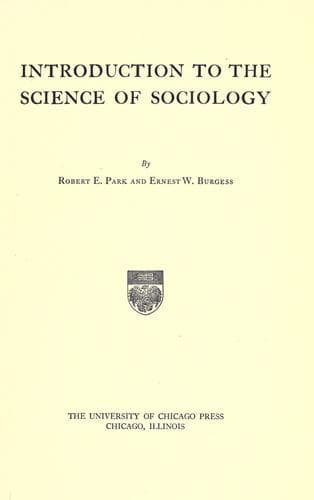
Introduction to the Science of SociologyPark, Robert Ezra
General
Introduction to the Science of Sociology
Park, Robert Ezra
Sociology
Criminological experiences appear also to confirm the notion of an
inherited sexual differentiation, in children as well as in adults.
According to various statistics, embracing not only the period of
childhood, but including as well the period of youth, we learn that
girls constitute one-fifth only of the total number of youthful
criminals. A number of different explanations have been offered to
account for this disproportion. Thus, for instance, attention has been
drawn to the fact that a girl's physical weakness renders her incapable
of attempting violent assaults upon the person, and this would suffice
to explain why it is that girls so rarely commit such crimes. In the
case of offenses for which bodily strength is less requisite, such as
fraud, theft, etc., the number of youthful female offenders is
proportionately larger, although here also they are less numerous than
males of corresponding age charged with the like offenses. It has been
asserted that in the law courts girls find more sympathy than boys, and
that for this reason the former receive milder sentences than the
latter; hence it results that in appearance merely the criminality of
girls is less than that of boys. Others, again, refer the differences in
respect of criminality between the youthful members of the two sexes to
the influences of education and general environment. Morrison, however,
maintains that all these influences combined are yet insufficient to
account for the great disproportion between the sexes, and insists that
there exists in youth as well as in adult life a specific sexual
differentiation, based, for the most part, upon biological differences
of a mental and physical character.
Such a marked differentiation as there is between the adult man and the
adult woman certainly does not exist in childhood. Similarly in respect
of many other qualities, alike bodily and mental, in respect of many
inclinations and numerous activities, we find that in childhood sexual
differentiation is less marked than it is in adult life. None the less,
a number of sexual differences can be shown to exist even in childhood;
and as regards many other differences, though they are not yet apparent,
we are nevertheless compelled to assume that they already exist
potentially in the organs of the child.
6. Racial Differences[63]
Public-domain text, read in full here on John Shaqi.
Reviews
Reviews
No reviews yet
Be the first to share your thoughts on this work.
Elsewhere in the archive
Join the Discussion
Join the discussion
Sign in to leave a comment or review.
Sign InorCreate an account