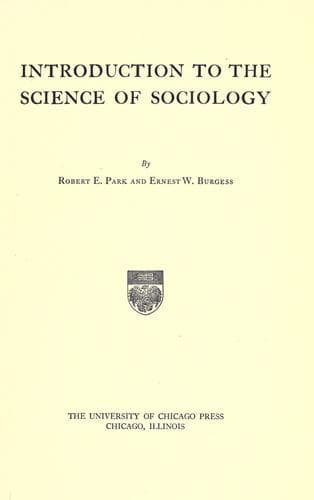
Introduction to the Science of SociologyPark, Robert Ezra
General
Introduction to the Science of Sociology
Park, Robert Ezra
Sociology
The results of the Cambridge expedition to the Torres Straits have shown
that in acuteness of vision, hearing, smell, etc., these peoples are not
noticeably different from our own. We conclude that the remarkable tales
adduced to the contrary by various travelers are to be explained, not by
the acuteness of sensation, but by the acuteness of interpretation of
primitive peoples. Take the savage into the streets of a busy city and
see what a number of sights and sounds he will neglect because of their
meaninglessness to him. Take the sailor whose powers of discerning a
ship on the horizon appear to the landsman so extraordinary, and set him
to detect micro-organisms in the field of a microscope. Is it then
surprising that primitive man should be able to draw inferences which to
the stranger appear marvelous, from the merest specks in the far
distance or from the faintest sounds, odors, or tracks in the jungle?
Such behavior serves only to attest the extraordinary powers of
observation in primitive man with respect to things which are of use and
hence of interest to him. The same powers are shown in the vast number
of words he will coin to denote the same object, say a certain tree at
different stages of its growth.
We concluded, then, that no fundamental difference in powers of sensory
acuity, nor, indeed, in sensory discrimination, exists between primitive
and civilized communities. Further, there is no proof of any difference
in memory between them, save, perhaps, in a greater tendency for
primitive folk to use and to excel in mere mechanical learning, in
preference to rational learning. But this surely is also the
characteristic of the European peasant. He will never commit things to
memory by thinking of their meaning, if he can learn them by rote.
In temperament we meet with just the same variations in primitive as in
civilized communities. In every primitive society is to be found the
flighty, the staid, the energetic, the indolent, the cheerful, the
morose, the even-, the hot-tempered, the unthinking, the philosophical
individual. At the same time, the average differences between different
primitive peoples are as striking as those between the average German
and the average Italian.
Public-domain text, read in full here on John Shaqi.
Reviews
Reviews
No reviews yet
Be the first to share your thoughts on this work.
Elsewhere in the archive
Join the Discussion
Join the discussion
Sign in to leave a comment or review.
Sign InorCreate an account