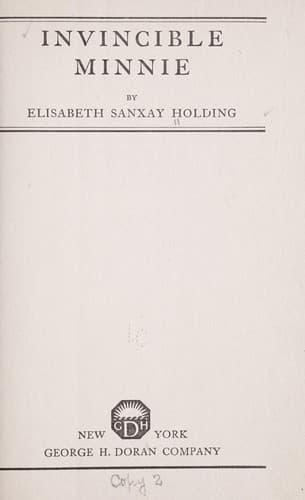
Bigamy -- Fiction; Man-woman relationships -- Fiction; Mothers -- Fiction; Sisters -- Fiction; Young women -- Fiction
She thought over Lionel with a passionate desire to do right; tried to
obtain guidance from her brain while her heart was dumb. She wondered
whether it did him more good to see how seriously she regarded his
offence, or whether it would have helped him more to forgive him. Never
considered it simply as a matter of cruelty or kindness. She was so
concerned with thinking of what was morally best for Lionel that she
neglected her own soul’s good.
And without doubt her soul suffered. She was becoming irritable,
intolerant, over-haughty, wrapped up in her own affairs. She needed
Lionel badly, needed his carelessness, his sweet temper. In spite of
that, she thought she was “getting over” it splendidly; being sensible,
and so on. She was able to eat and to sleep and to live as usual; even
looked the same. And then, suddenly, one night, woke up with a piercing
pain, a most irresistible tenderness and longing for him.
“How could I have been so heartless!” she asked herself, sitting up in
bed, and clasping her hands hysterically. “What did it matter, what he
did? What do I care about that? Lionel! Darling! I want you back so!”
She got up then and there and wrote to him, addressing it in care of
Horace.
V
He came the next evening. Quite in accordance with his extreme character
he had in ten days’ time become unnecessarily wretched and shabby in
looks and manners. He was even thinner.
He had looked and looked for a job, he said, but no one would have an
inexperienced man of his age. He was in despair. So that Frances could
not for an instant maintain her injured majesty, but had to comfort and
fortify him, even to cry over him a little.
“Don’t be discouraged!” she entreated, stroking his hair. “Poor old
boy!”
“But I haven’t a penny! I used that money in the bank. I’ve moved into a
cheap boarding-house. But still I can’t manage. And my remittance
doesn’t come until January.”
Followed an extraordinary period for the lovers. Lionel pawned his
watch, his travelling-bag, his cuff-buttons, one thing after another. He
would get down to his last dollar and come to Frankie, white with
despair, and she would think of something else to do. He would come back
from each of these visits to the pawn-shop jubilant and pleading for a
“celebration,” but Frankie never permitted it. He put everything into
her hands without reserve, and received back what she allowed him,
unquestioningly. They frequented cinemas instead of theatres; he found a
cheaper brand of cigarettes. He did it all, too, with such generosity
and simplicity that Frankie was utterly enslaved. He was her child, her
ewe lamb, she watched over him, planned for him, guided him, with
passionate devotion.
Public-domain text, read in full here on John Shaqi.
Reviews
Reviews
No reviews yet
Be the first to share your thoughts on this work.
Elsewhere in the archive
Join the Discussion
Join the discussion
Sign in to leave a comment or review.
Sign InorCreate an account