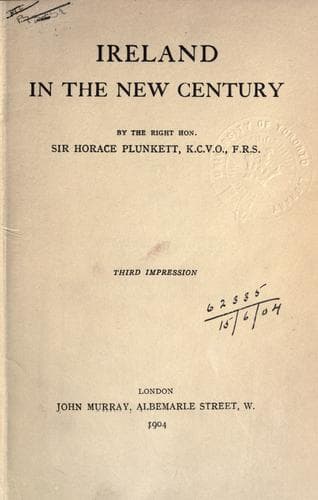
Ireland In The New CenturyPlunkett, Horace Curzon, Sir
History
Ireland In The New Century
Plunkett, Horace Curzon, Sir
Ireland -- Economic conditions; Ireland -- Politics and government -- 1901-1910; Irish question
The movement for the reorganisation of Irish agricultural and industrial
life, to which I have already frequently referred, must now be described
in practical operation. Before I do this, however, there are two lines
of criticism which the very mention of a new movement may suggest, and
which I must anticipate. Every year has its tale of new movements,
launched by estimable persons whose philanthropic zeal is not balanced
by the judgment required to discriminate between schemes which possess
the elements of permanence, and those which depend upon the enthusiasm
or financial support of their promoters, and are in their nature
ephemeral. There is, consequently, a widespread and well justified
mistrust of novel schemes for the industrial regeneration of Ireland. I
confess to having had my ingenuity severely taxed on some occasions to
find a sympathetic circumlocution wherewith to show cause for declining
to join a new movement, my real reason being an inward conviction that
nothing except resolutions would be moved. In the complex problem of
building up the economic and social life of a people with such a
history as ours, we must resist the temptation to multiply schemes
which, however well intended, are but devices for enabling individuals
to devolve their responsibilities upon the community or upon the
Government, and which owe their bubble reputation and brief popularity
to this unconscious humouring of our chief national defect. On the
contrary, we must seek to instil into the mind of each individual the
too little recognised importance of his own contribution to the sum of
national achievement. The building of character must be our paramount
object, as it is the condition precedent of all social and economic
reform in Ireland. To explain the principles by the observance of which
the agency of the association may be utilised as an economic force,
while at the same time the industrial character of the individual may be
developed, was one of the chief aims I had in view in the foregoing
analysis of the Irish mind and character, as they have emerged from
history and are stunted in their growth by present influences. The facts
about to be recited will, I hope, suffice to prove that the reformer in
Ireland, if he has a true insight into the great human problem with
which he is dealing, may find in the association not only a healthy
stimulus to national activities, but also a means whereby the assistance
of the State may be so invoked and applied that it will concentrate, and
not dissipate, the energies of the people.
Public-domain text, read in full here on John Shaqi.
Reviews
Reviews
No reviews yet
Be the first to share your thoughts on this work.
Elsewhere in the archive
Join the Discussion
Join the discussion
Sign in to leave a comment or review.
Sign InorCreate an account