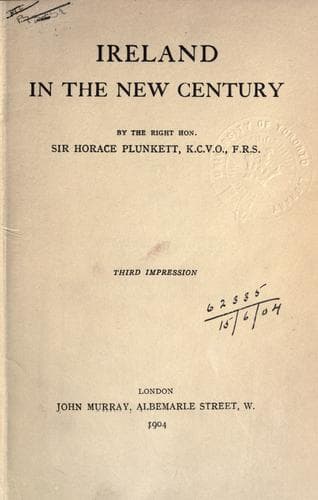
Ireland In The New CenturyPlunkett, Horace Curzon, Sir
History
Ireland In The New Century
Plunkett, Horace Curzon, Sir
Ireland -- Economic conditions; Ireland -- Politics and government -- 1901-1910; Irish question
The other criticism which I think it necessary to anticipate would, if
ignored, leave room for a wrong impression as to much of the work which
is being done both on the self-help and on the State-aid sides of the
new movement. Education, it will be said, is the only real solvent to
the range of problems discussed in this book, most other agencies of
social and economic reform being of doubtful efficacy and, if they tend
to postpone educational effort, positively harmful. There is much truth
in this view. But it must be remembered that the backward condition of
our economic life is due mainly to the fact that our educational systems
have had little regard to our history or economic circumstances. We
must, therefore, at this stage in our national development give to
education a much wider interpretation than that which is usually applied
to the term. We cannot wait for a generation to grow up which has been
given an education calculated to fit it for the modern economic
struggle, even if there were any probability that the necessary reforms
would soon be carried against the prejudices which are aroused by any
proposal to train the minds, or even the hands and eyes, of the rising
generation. In the meantime much of the work, both voluntary and
State-aided, now initiated in Ireland, must consist of educating adults
to introduce into their business concerns the more advanced economic and
scientific methods which the superior education of our rivals in
agriculture and industry abroad has enabled them to adopt, and which my
experience of Irish work convinces me our people would have adopted long
ago if they had had similar educational advantages. And I would further
point out that there is no better way of promoting the reform of
education in the ordinary, the pedagogic, sense, than by bringing to
bear upon the minds of parents those educational influences which are
calculated to convince them of the advantage of improved practical
education for their children. So to the economist and to the
educationist alike I would submit that the new work of economic and
social reform should be judged as a whole, and not prejudged by that
hypercriticism of details which ignores the fact that the conditions
with which it is attempted to deal are wholly unprecedented. I am quite
content that the movement which I am about to describe should be
ultimately known and judged by its fruits. Meanwhile, I think that to
the intelligent critic it will sufficiently justify its existence if it
continues to exist.
* * * * *
Public-domain text, read in full here on John Shaqi.
Reviews
Reviews
No reviews yet
Be the first to share your thoughts on this work.
Elsewhere in the archive
Join the Discussion
Join the discussion
Sign in to leave a comment or review.
Sign InorCreate an account