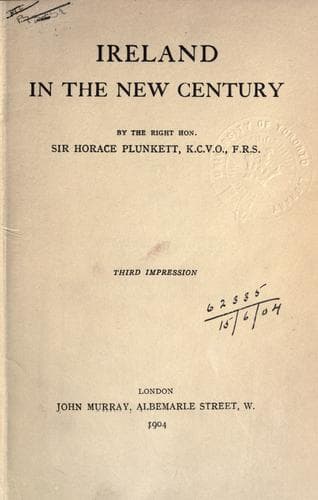
Ireland In The New CenturyPlunkett, Horace Curzon, Sir
History
Ireland In The New Century
Plunkett, Horace Curzon, Sir
Ireland -- Economic conditions; Ireland -- Politics and government -- 1901-1910; Irish question
The story of the new movement, which must now be told, begins in the
year 1889, when a few Irishmen, the writer of these pages among them,
set themselves the task of bringing home to the rural population of
Ireland the fact that their prosperity was in their own hands much more
than they were generally led to believe. I have already pointed out that
in order to direct the Irish mind towards practical affairs and in order
effectively to arouse and apply the latent capacities of the Irish
people to their chief industry, agriculture, we must rely upon
associative, as distinct from individual effort; or, in other words, we
must get the people to do their business together rather than
separately as the English do. Fortunately for us, it happened that this
course, which was clearly indicated by the character and temperament of
the people, was equally prescribed by economic considerations. The
population and wealth of Ireland are, I need hardly say, so
predominantly agricultural that the welfare of the country must depend
upon the welfare of the farming classes. It is notorious that the
industry by which these classes live has for the last quarter of a
century become less and less profitable. It is also recognised that the
prime cause of agricultural depression, foreign competition, is not
likely to be removed, while that from the colonies is likely to
increase. The extraordinary development of rapid and cheap transit,
together with recently invented processes of preservation, have enabled
the more favoured producers in the newly developed countries of both
hemispheres successfully to enter into competition in the British
markets with the farmers of these islands. The agricultural producers in
other European countries, although to some extent protected by tariffs,
have had to face similar conditions; but in most of these countries,
though not in the United Kingdom, the farmers have so changed their
methods, to meet the altered circumstances, that they seem to have
gained by improvement at home as much as they have lost by competition
from abroad Thus our farmers find themselves harassed first by the
cheaper production from vast tracts of virgin soil in the uttermost
parts of the earth, and secondly by a nearer and keener competition
from the better organised and better educated producers of the
Continent.
Public-domain text, read in full here on John Shaqi.
Reviews
Reviews
No reviews yet
Be the first to share your thoughts on this work.
Elsewhere in the archive
Join the Discussion
Join the discussion
Sign in to leave a comment or review.
Sign InorCreate an account