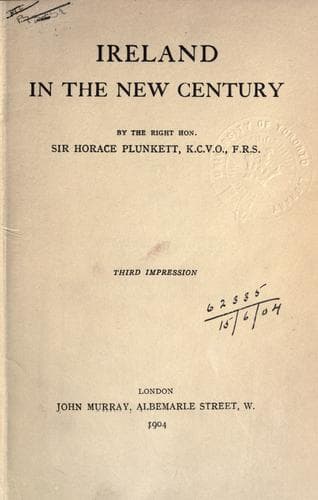
Ireland In The New CenturyPlunkett, Horace Curzon, Sir
History
Ireland In The New Century
Plunkett, Horace Curzon, Sir
Ireland -- Economic conditions; Ireland -- Politics and government -- 1901-1910; Irish question
When we arrived at the conclusion that the introduction of the principle
of agricultural co-operation was a vital necessity, the first practical
question which had to be decided was how the industrial army, which was
to do battle for Ireland's position in the world market, should be
organised and disciplined for the task. It is evident that before a body
of men who have never worked together can form a successful commercial
combination, they must be provided with a constitution and set of rules
and regulations for the conduct of their business. These must be so
skilfully contrived that they will harmonise all the interests involved.
And when an arrangement has been come to which is, not only in fact but
also obviously, equitable, it remains as part of the process of
organisation to teach the participants in the new project the meaning,
and to imbue them with the spirit, of the joint enterprise into which
they have been persuaded to enter with perhaps no very clear
understanding of all that is involved. There were in Ireland no
precedents to guide us and no examples to follow, but the co-operative
movement in England appeared to furnish most of the principles involved
and a perfect machinery for their application.[37] So Lord Monteagle and
Mr. R.A. Anderson, my first two associates in the New Movement, joined
me as regular attendants at the annual Co-operative congresses. We were
assiduous seekers after information at the head-quarters of the
Co-operative Union in Manchester. We had the good fortune to fall in
with Vansittart Neale, and Tom Hughes, both of whom have passed away,
and with Mr. Holyoake, who, with the exception of Mr. Ludlow, is now the
sole survivor of that noble group of practical philanthropists, the
Christian Socialists. Mr. J.C. Gray, who succeeded Mr. Vansittart Neale
as the General Secretary of the Co-operative Union, gave us invaluable
help and continues to do so to this day. The leaders of the English
movement sympathised with our efforts. The Union paid us the compliment
of constituting our first converts its Irish Section. Liberal support
was given out of the central English funds towards the cost of the
missionary work which was to spread co-operative light in the sister
isle. We can never forget the generosity of the workingmen in England in
giving their aid to the Irish farmers, especially when it is remembered
that they had no sanguine anticipations for the success of our efforts
and no prospect of advantages to themselves if we did succeed.
Public-domain text, read in full here on John Shaqi.
Reviews
Reviews
No reviews yet
Be the first to share your thoughts on this work.
Elsewhere in the archive
Join the Discussion
Join the discussion
Sign in to leave a comment or review.
Sign InorCreate an account