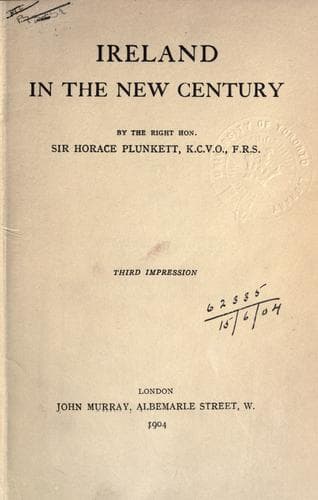
Ireland In The New CenturyPlunkett, Horace Curzon, Sir
History
Ireland In The New Century
Plunkett, Horace Curzon, Sir
Ireland -- Economic conditions; Ireland -- Politics and government -- 1901-1910; Irish question
It must be admitted that the outlook was not altogether rosy.
Agricultural co-operation had never succeeded in England, where it
seemed to be accepted as one of the disappointing limitations of the
co-operative movement that it did not apply to rural communities in
these islands. There were also in Ireland the peculiar difficulties
arising from ceaseless political and agrarian agitation. It was
naturally asked--did Irish farmers possess the qualities out of which
co-operators are made? Had they commercial experience or business
education? Had they business capacity? Would they display that
confidence in each other which is essential to successful association,
or indeed that confidence in themselves without which there can be no
business enterprise? Could they ever be induced to form themselves into
societies, and to adopt, and loyally adhere to those rules and
regulations by which alone equitable distribution of the responsibility
and profit among the participants in the joint undertaking can be
assured, and harmony and successful working be rendered possible? Then,
our best-informed Irish critics assured us that voluntary association
for humdrum business purposes, devoid of some religious or political
incentive, was alien to the Celtic temperament and that we should wear
ourselves out crying in the wilderness. We were told that Irishmen can
conspire but cannot combine. Economists assured us that even if we
succeeded in getting farmers to embark on the projected enterprises,
financial disaster would be the inevitable result of our attempts to
substitute in industrial undertakings, ever becoming more technical and
requiring more and more commercial knowledge and experience, democratic
management for one-man control.
Public-domain text, read in full here on John Shaqi.
Reviews
Reviews
No reviews yet
Be the first to share your thoughts on this work.
Elsewhere in the archive
Join the Discussion
Join the discussion
Sign in to leave a comment or review.
Sign InorCreate an account