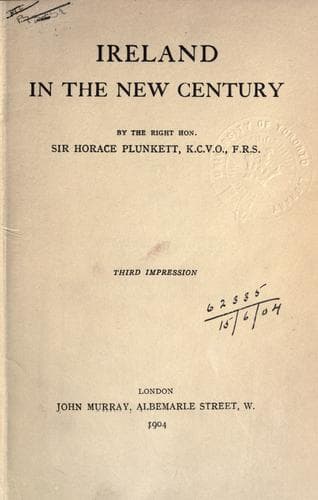
Ireland In The New CenturyPlunkett, Horace Curzon, Sir
History
Ireland In The New Century
Plunkett, Horace Curzon, Sir
Ireland -- Economic conditions; Ireland -- Politics and government -- 1901-1910; Irish question
In the year 1894 the movement had gathered volume to such an
extent--although the societies then numbered but one for every twenty
that are in existence to-day--that it became beyond the power of a few
individuals to direct its further progress. In April of that year a
meeting was held in Dublin to inaugurate the Irish Agricultural
Organisation Society, Ltd. (now commonly known as the I.A.O.S.), which
was to be the analogue of the Co-operative Union in England. In the
first instance it was to consist of philanthropic persons, but its
constitution provided for the inclusion in its membership of the
societies which had already been created and those which it would itself
create as time went on. It had, and has to-day, a thoroughly
representative Committee. I was elected the first President, a position
which I held until I entered official life, when Lord Monteagle, a
practical philanthropist if ever there was one, became my successor.
Father Finlay, who joined the movement in 1892, and who has devoted the
extraordinary influence which he possesses over the rural population of
Ireland to the dissemination of our economic principles, became
Vice-President. Both he and Lord Monteagle have been annually re-elected
ever since.
The growth of the movement in the last nine years under the fostering
care of the I.A.O.S. is highly satisfactory. By the autumn of this year
(1903) considerably over eight hundred societies had been established,
and the number is ever growing; of these 360 were dairy, and 140
agricultural societies, nearly 200 agricultural banks, 50 home
industries societies, 40 poultry societies, while there were 40 others
with miscellaneous objects. The membership may be estimated--I am
writing towards the end of the Society's statistical year--at about
80,000, representing some 400,000 persons. The combined trade turnover
of these societies during the present year will reach approximately
£2,000,000, a figure the meaning of which can only be appreciated when
it is remembered that the great majority of the associated farmers are
in so small a way of business that in England they would hardly be
classed as farmers at all.
Public-domain text, read in full here on John Shaqi.
Reviews
Reviews
No reviews yet
Be the first to share your thoughts on this work.
Elsewhere in the archive
Join the Discussion
Join the discussion
Sign in to leave a comment or review.
Sign InorCreate an account